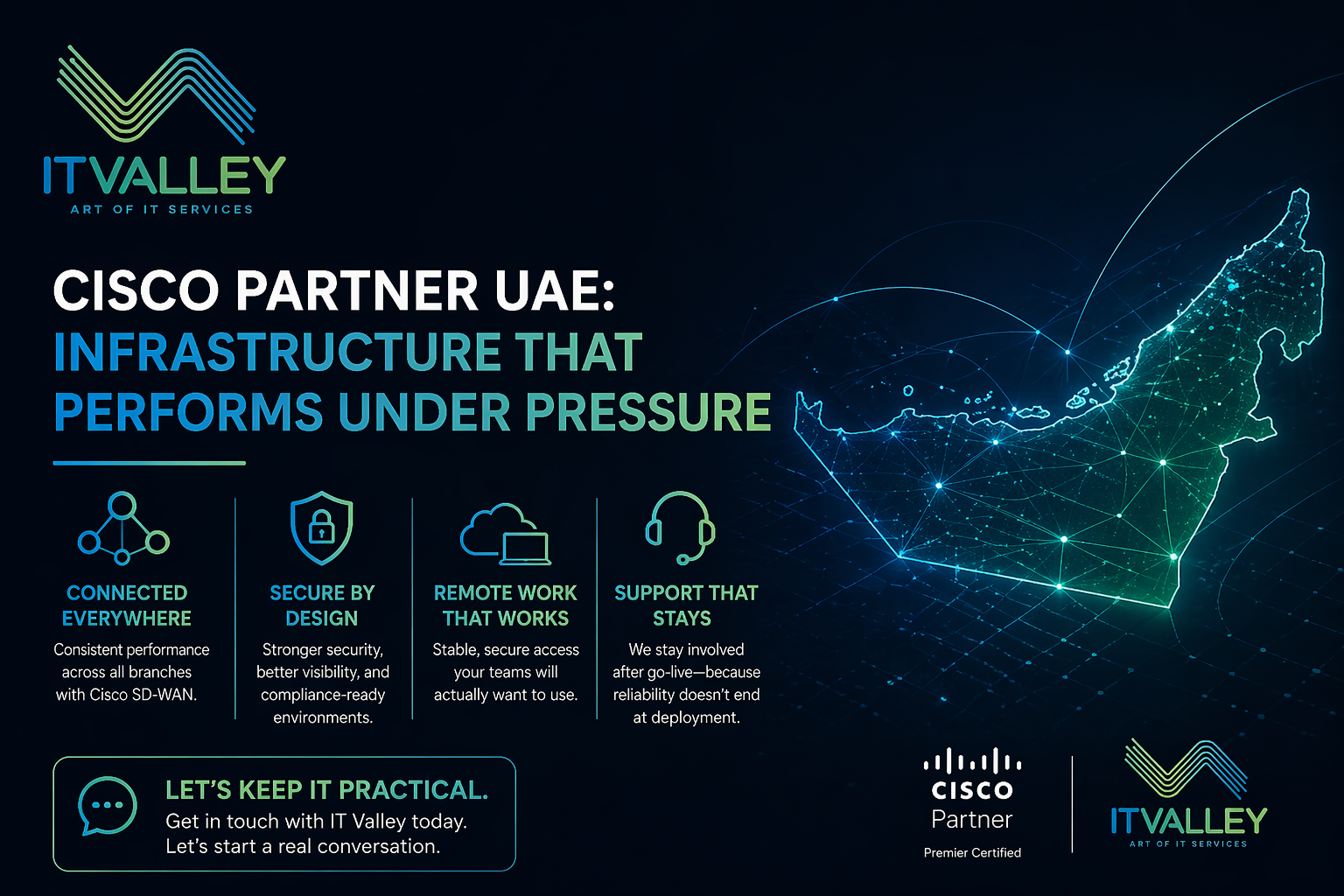
Cisco Partner UAE: What Actually Matters When Your Infrastructure Is Under Pressure
At some point, every growing company in the UAE hits the same wall. Everything is working fine… until suddenly it isn’t.
The network slows down. Remote teams start complaining. Access becomes inconsistent. And what used to be “a small IT issue” quickly turns into something that affects your clients, your deadlines, and your revenue. That’s usually the moment companies start rethinking what a Cisco Partner in the UAE is supposed to do.
Let’s be honest: It’s not about buying equipment. It’s about making sure your business doesn’t stop when things get busy.
The Gaps We See Every Day (Across UAE Enterprises)
Most of the companies we speak to aren’t starting from zero. They’ve already invested in infrastructure, and some of it is actually good. But there are always gaps—not theoretical ones, but practical, day-to-day issues that eat away at productivity:
-
Branches don’t feel connected: Even with SD-WAN in place, performance between locations isn’t consistent. Some offices always seem “slower than others.”
-
Security exists… but confidence doesn’t: Tools are deployed, and dashboards are green—but no one is fully sure how the system would react under a real-world threat.
-
Remote access works, but people avoid using it: Which usually tells you everything you need to know about the user experience.
-
Support becomes reactive instead of reliable: Once deployment is done, response times start slipping, and your internal teams end up handling more than they should.
One client once told us after a long week of troubleshooting: “Nothing completely failed… but everything felt unstable.” In the UAE’s fast-paced market, that’s sometimes worse than a full outage.
Why Cisco Still Leads — When It’s Done Right
If you’ve worked in enterprise IT, you already know this: Cisco isn’t the cheapest option in the room. But companies in the Emirates continue to invest in it because, when designed properly, it simply holds up better under pressure.
The issue is rarely the technology itself; it’s how it’s implemented. We’ve seen environments with high-end Cisco products that still struggle daily—simply because the design didn’t match how the business actually operates on the ground.
How IT Valley Approaches Your Infrastructure Differently
At IT Valley, we don’t start with a catalog. We start with the hard questions:
-
Where does performance actually drop during the day?
-
When do your users complain the most?
-
What happens during peak load—not average load?
What This Looks Like in Real Projects
1. Networking: Consistency Over Coverage
In several Dubai offices we’ve audited, Wi-Fi wasn’t “down”—it was just inconsistent. This meant dropped calls and slow file access during peak hours. Fixing that wasn’t about adding more hardware; it was about redesigning how traffic flows across the environment to ensure “it works” means “it works every time.”
2. Security: Clarity Over Complexity
A common pattern in the UAE is investing in multiple security layers while visibility remains limited. Instead of adding more tools, we focus on making existing systems work together, reducing blind spots, and aligning the setup with UAE compliance requirements without overcomplicating your life.
3. Remote Work: Adoption is the Only Metric
Technically, most companies already “have” remote access. But if your employees complain about it or avoid using it, then it’s a failed investment. Small improvements in stability and login experience often make a bigger difference than any major system overhaul.
Why Clients Choose to Stay With Us
Not because we’re the only Cisco Partner in the UAE, but because we keep things practical:
-
We stay involved after go-live: Support isn’t a ticket number; it’s a relationship.
-
We adjust based on real usage: What works in theory doesn’t always work in Dubai at 10 AM on a busy Monday.
-
We avoid overengineering: Good architecture should make your life easier, not more expensive.
A Simple Way to Look at Your Current Risk
If your system slows down tomorrow at 10 AM:
-
Do you know exactly where the issue will likely be?
-
Will your team be able to handle it internally?
-
Or will it turn into a full-day problem?
If you don’t have clear answers, you don’t need a full rebuild. In many cases, a focused review of your current setup is enough to uncover what’s misconfigured or adding unnecessary complexity.
Let’s Keep It Practical
If you’re planning to scale or fix ongoing issues, we can go through your current setup together. We’ll give you a clear view of what’s working, what isn’t, and how to improve it without the heavy sales pitch.