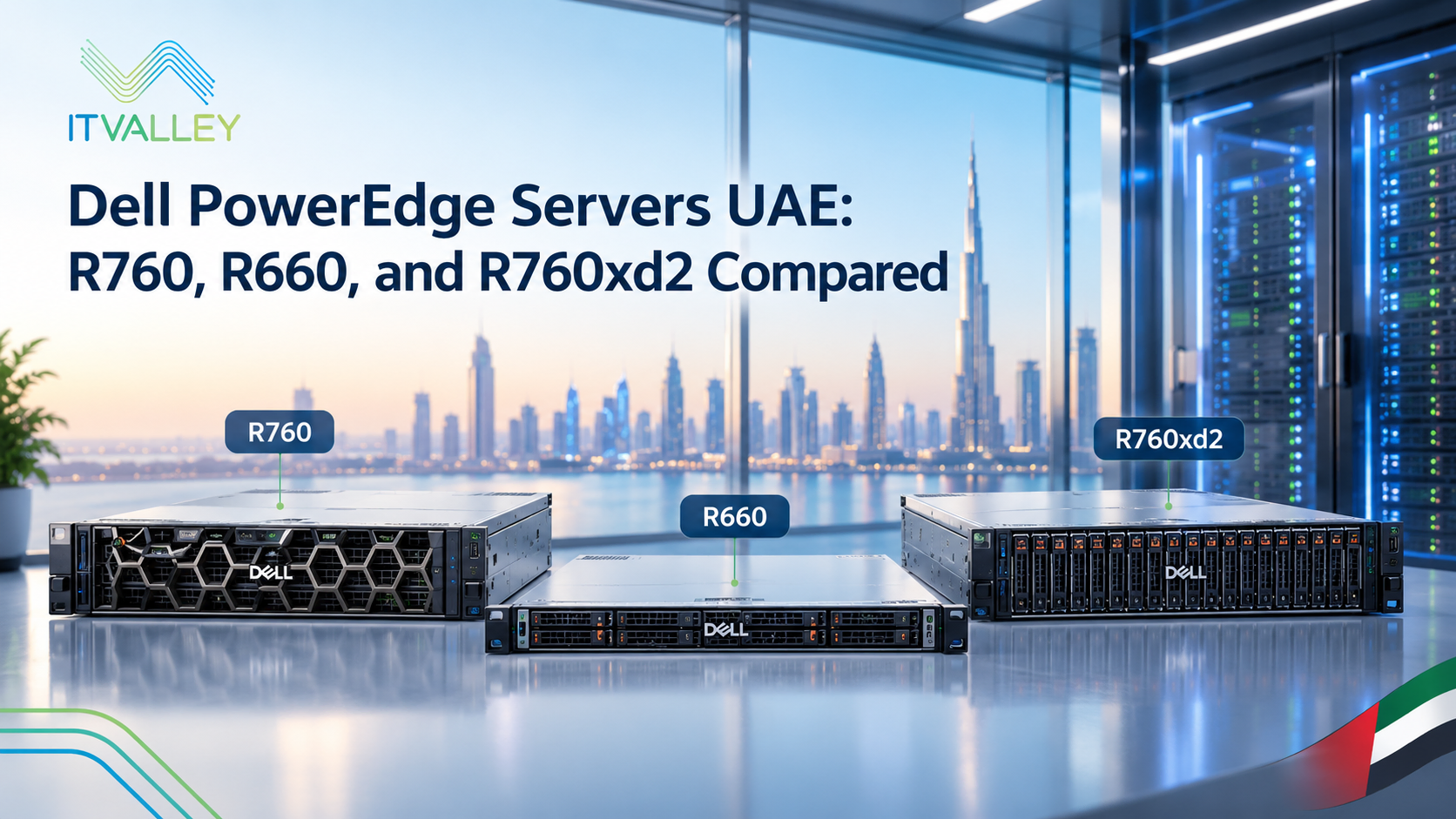
Dell PowerEdge Servers UAE: R760, R660, and R760xd2 Compared
Dell PowerEdge servers UAE buyers ask about most often fall into three specific models right now. The R760, the R660, and the R760xd2. All three sit in Dell’s current 16th-generation PowerEdge lineup. All three share the same Intel Xeon processor family under the hood. But they’re built for genuinely different jobs, and picking the wrong one is an expensive mistake to walk back later.
IT Valley is a Dell Titanium partner in the UAE. We supply and deploy PowerEdge servers for businesses across Dubai and Abu Dhabi. Want the full picture of Dell’s enterprise lineup? Our Dell Partner UAE page covers that ground. This post goes deeper into one specific decision. Which of these three servers actually fits your workload.
Why These Three Models Keep Coming Up Together
The R760 and R660 run on the same processor family. Same chipset. Largely the same memory setup too. The real difference is form factor and room to expand, not raw processing power. The R760xd2 shares that same processor lineage, but it’s built around a totally different priority. Storage density, not compute density.
That shared DNA is exactly why buyers get confused. A spec sheet comparison can make all three look similar at a glance, when the real differences only show up once you know what each one is actually optimized for.
R760: The Default Choice for Most UAE Workloads
The R760 is Dell’s current 2U flagship, and for good reason. It supports up to two Intel Xeon Scalable processors, with as many as 56 or 64 cores each depending on the generation you configure. Thirty-two DDR5 memory slots give you room for up to 8TB of RAM, which covers nearly any virtualization or database workload a UAE business is likely to run.
Storage flexibility is where the R760 really earns its reputation. Up to 24 drive bays. Support for the newest NVMe drives. Enough PCIe slots for GPUs too, if your workload needs that boost. For UAE companies running VDI, SQL databases, or virtualization at real scale, this is almost always where we start the conversation.
R660: Same Power, Smaller Footprint
The R660 is essentially the R760’s compact sibling. Same processor family. Same core memory architecture. It drops into a 1U chassis instead of 2U, which matters a lot once you’re racking dozens of servers in a UAE data center where every rack unit has a real cost.
The trade-off is fewer drive bays, with less room to expand overall. For compute-heavy jobs that don’t need huge local storage, that’s rarely a problem. Web app clusters, compute nodes in a virtualization farm, or dense Kubernetes setups all fit the R660 well. We recommend it when density matters more than local storage space. That’s a common priority for growing UAE colocation and data center tenants.
R760xd2: Built for Storage, Not Raw Compute
The R760xd2 looks similar to the R760 from the outside, but it’s a different machine entirely once you open it up. Memory tops out lower, at 1.5TB across 16 DIMM slots instead of the R760’s 32. Processor core counts are capped lower too. None of that is a flaw. It’s a deliberate trade-off, because this server exists for one job: packing enormous amounts of storage into a single 2U chassis.
With room for up to 28 drives across front, mid, and rear bays, the R760xd2 can hold well over 600TB of raw storage in one box. That makes it the right call for file servers, object storage, video archives, and content delivery jobs. Exactly the kind of data-heavy work a lot of UAE media, logistics, and surveillance-heavy businesses run. Forcing this job onto a standard R760 usually means buying far more compute than you need, just to get the drive bays you actually wanted.
Matching the Server to Your Actual Workload
A lot of UAE procurement conversations start with budget, which is understandable but backward. The better starting point is what the server actually needs to do day to day.
Running a mixed virtualization setup with a reasonable amount of local storage? The R760 covers that comfortably, with room to grow. Building a dense compute cluster where rack space is the real limit? The R660 gets you more servers in the same footprint. Archiving huge volumes of data, whether that’s surveillance footage, media files, or backups? The R760xd2 is built for exactly that. Swapping in a compute-focused server for this job usually ends in an expensive rebuild within a year or two.
Generation Matters as Much as Model
All three sit in Dell’s 16th-generation lineup, built around 4th and 5th Gen Intel Xeon processors. That’s a real jump from older 14th and 15th-gen PowerEdge gear still running in plenty of UAE server rooms. DDR5 memory. PCIe Gen5 expansion. Notably better power efficiency per core too, all built into this generation.
If your business still runs older PowerEdge hardware, and you’re weighing a refresh, the jump in generation often matters more than which specific model you pick. We walk clients through that honestly. Some older units genuinely need replacing. Others still have real life left in them.
Power and Cooling: The Part Procurement Often Forgets
Server specs get all the attention. But power and cooling capacity matter just as much, once real hardware goes into a UAE data center rack. The R760 and R760xd2 support a range of power supplies, from around 700W up to over 3000W, depending on your setup and redundancy needs. A fully loaded R760 with GPUs draws a lot more power than a storage-focused R760xd2 in the same chassis size.
This isn’t just a spec sheet detail. UAE colocation facilities often price rack space partly on power draw, not just unit count. A server pulling more power than your contract allows becomes an unplanned cost. Or worse, a capacity problem discovered only after the hardware is already racked. We factor this into sizing talks early, not as a surprise during deployment.
How IT Valley Sizes PowerEdge Deployments
Workload-first sizing. We start with what you’re really running, not a default model pulled off a price list.
Storage versus compute, decided properly. R760xd2 for storage-heavy jobs. R760 or R660 for compute-focused ones. Based on real needs.
Genuine Dell hardware with full warranty. Every unit sourced through official channels, with support that holds up across the UAE.
Deployment handled end to end. Racking, firmware setup, and iDRAC configuration done before the server touches production traffic.
Frequently Asked Questions
Can I mix R760 and R660 servers in the same deployment? Yes. Plenty of UAE clients run R760s for storage-heavy nodes and R660s for pure compute nodes within the same cluster, matching each server to the specific role it plays.
Is the R760xd2 overkill if I just need extra storage for one application? Sometimes, yes. If your storage needs are modest, a standard R760 with more drive bays configured might be simpler. The R760xd2 earns its place once you’re genuinely pushing into hundreds of terabytes.
How do I know if my current PowerEdge server needs replacing? It depends on age, workload growth, and whether it’s still under active Dell support. We assess your current hardware honestly and tell you if it still has real life left, rather than pushing a refresh you don’t need yet.
Talk to IT Valley About Your PowerEdge Deployment
Not sure whether the R760, R660, or R760xd2 fits your UAE workload? Get in touch with IT Valley’s certified Dell engineers for a straight sizing assessment based on what your business actually runs.