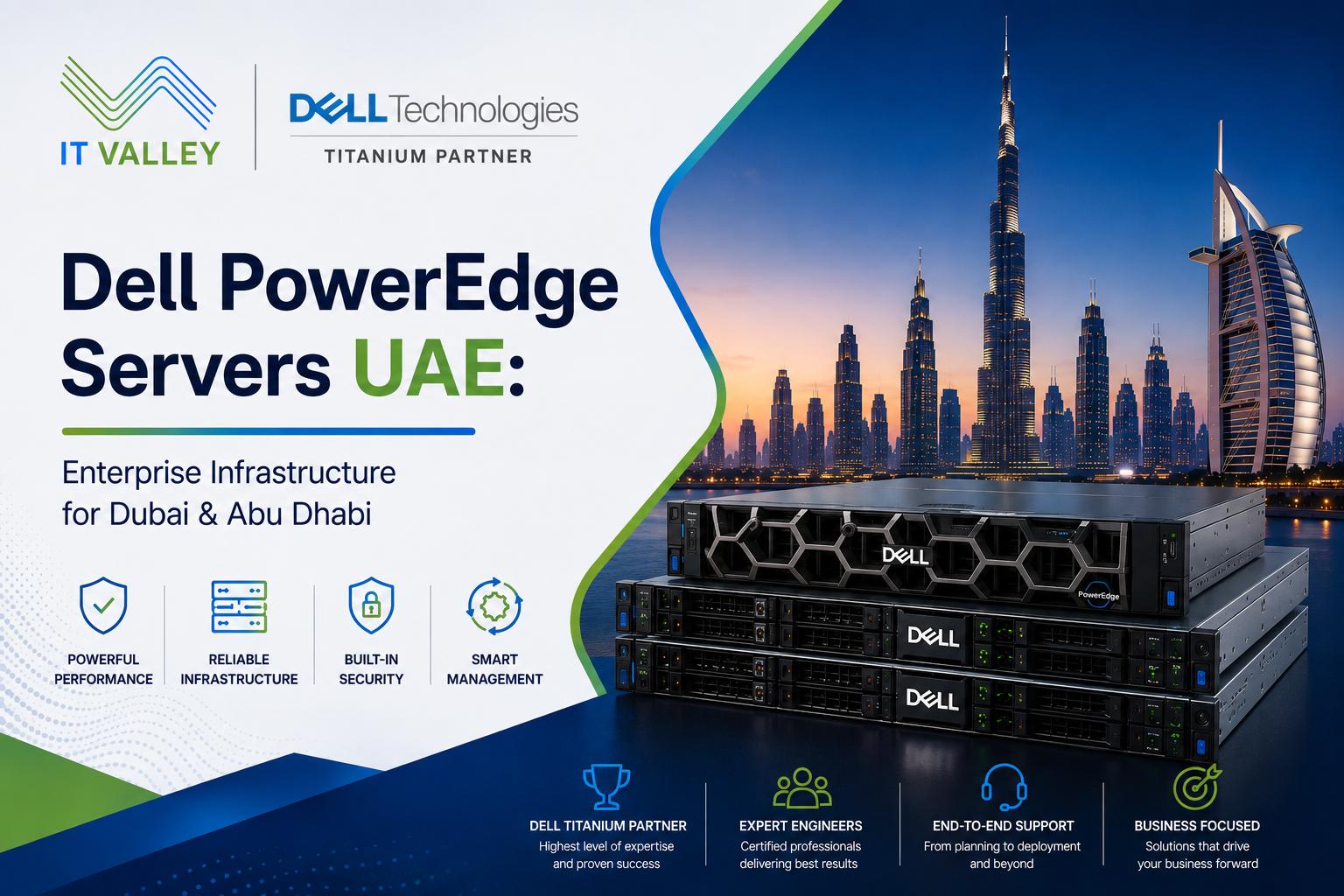
Dell PowerEdge Servers UAE: Enterprise Infrastructure for Dubai & Abu Dhabi
Dell PowerEdge servers UAE — if you searched that, you’re probably not browsing. You have a data center requirement, a refresh cycle coming up, or a project on a deadline.
IT Valley is a Dell Titanium partner in UAE — the highest tier in Dell’s program. We supply genuine Dell PowerEdge servers across Dubai and Abu Dhabi. We also configure them for production environments and support them after deployment. This article covers which models fit which environments and what a proper server deployment actually involves.
Why PowerEdge Is the Data Center Standard in UAE
Walk into most enterprise environments in Dubai and you’ll find PowerEdge in the rack. That didn’t happen by accident.
Dell PowerEdge hits a balance that’s hard to replicate. It delivers enterprise reliability, mature remote management through iDRAC, and support that works in the UAE. When something fails at 2am, the question isn’t just “is the hardware good.” It’s “can someone diagnose and fix it without waiting days for a part.”
IT Valley answers yes to both. As a Dell Titanium partner, we get priority support escalation, faster parts access, and direct lines to Dell’s regional engineering team.
Dell PowerEdge Gen 16 — What Changed and Why It Matters
Gen 16 brought real improvements — not just incremental spec bumps.
These servers support DDR5 memory, which increases bandwidth for memory-bound workloads. Think large databases, virtualization hosts, and AI inference jobs. They also ship with PCIe Gen 5 slots. That doubles the bandwidth available for NVMe storage and GPU cards compared to Gen 15.
For UAE enterprises evaluating a refresh, the performance improvement is genuine. It’s most visible in virtualization and database-heavy environments. IT Valley runs a TCO comparison before any refresh decision. Sometimes the existing hardware has more life left than expected. Other times, the refresh pays for itself faster than the finance team anticipates.
Which PowerEdge Model Fits Your Environment
Getting the model wrong costs money in both directions. Too small and you hit limits within 18 months. Too large and you pay for capacity that sits idle for years.
Dell PowerEdge R660 and R760 — Mainstream Enterprise
These are the models IT Valley deploys most often for Dubai and Abu Dhabi enterprises.
PowerEdge R660 is a compact 1U dual-socket server. It suits environments where rack density matters — hosting providers, enterprises consolidating a crowded rack, or teams that need maximum compute in minimum space. With support for up to 8 NVMe drives and high-core-count Intel Xeon processors, it handles virtualization and demanding application servers well.
PowerEdge R760 is the 2U workhorse. It offers more drive bays, more expansion options, and better thermal headroom. For UAE enterprises running VMware clusters, Hyper-V environments, or SQL Server workloads, the R760 is often the right starting point. It handles the majority of enterprise data center requirements without the cost of a more specialized platform.
Dell PowerEdge R960 — When Scale Demands It
For larger UAE enterprises — major financial institutions, telecoms, government data centers — the R960 delivers 4-socket configurations that dual-socket platforms can’t match.
More processors mean more memory capacity, more PCIe lanes, and higher overall throughput. The R960 suits very large in-memory databases, high-core-count requirements for licensed enterprise applications, and workloads that genuinely need 4-socket architecture.
However, most UAE enterprises don’t need the R960. IT Valley will tell you when the R760 is sufficient — because recommending more hardware than necessary doesn’t serve anyone.
Dell PowerEdge T-Series — Branch Offices and Smaller Environments
Not every deployment needs rack infrastructure. For UAE branch offices and smaller standalone environments, Dell tower servers deliver enterprise reliability without rack mounting.
The PowerEdge T560 handles file services, Microsoft applications, and small-scale virtualization for UAE offices outside the primary data center. It also allows consistent management from a single Dell console — whether the server sits in a Dubai data center or a standalone cabinet in an Abu Dhabi branch.
What a Proper PowerEdge Deployment Involves
Supplying the hardware is the easy part. What happens after it arrives determines whether the deployment succeeds or creates problems.
IT Valley covers physical installation, BIOS and firmware baseline setup, RAID configuration, iDRAC setup, and integration with the client’s monitoring environment.
iDRAC is worth mentioning specifically. It provides hardware health monitoring, out-of-band console access, and automated alerting. But it only delivers those benefits when configured correctly. So IT Valley sets up iDRAC as part of every deployment — not as an optional extra.
RAID configuration is where shortcuts create lasting problems. A RAID 5 setup that looks adequate can leave workloads exposed during a rebuild if drive capacity is sized incorrectly. Instead of applying a generic template, IT Valley matches RAID level, stripe size, and cache policy to the specific workload.
After deployment, we also provide documentation that captures what was deployed and why. Any engineer can work on the environment later without reverse-engineering someone else’s decisions.
Dell PowerEdge and UAE Compliance
For UAE financial institutions and government entities, the server layer has direct compliance implications.
CBUAE business continuity requirements affect how PowerEdge clusters need to be designed — specifically HA configurations, replication, and failover. Dell PowerEdge with VMware vSphere provides the virtualization layer that makes RPO and RTO targets achievable in practice.
Data residency requirements for regulated industries are also satisfied by on-premise PowerEdge deployment. Your data stays within UAE jurisdiction — not in a cloud environment whose regional boundaries you may not fully control.
IT Valley builds compliance requirements into PowerEdge deployments from day one. That’s easier and cheaper than retrofitting them afterward.
FAQ: Dell PowerEdge Servers UAE
Is IT Valley an authorized Dell PowerEdge supplier in UAE?
Yes. IT Valley holds Dell Titanium status and supplies genuine PowerEdge servers with official UAE warranty coverage. Not grey-market hardware — and not refurbished equipment presented as new.
What’s the difference between PowerEdge Gen 15 and Gen 16?
Gen 16 supports DDR5 memory and PCIe Gen 5. Both deliver meaningfully higher bandwidth than Gen 15. For new deployments, Gen 16 is typically the right choice. For expansions to existing Gen 15 environments, Gen 15 hardware may still be the better fit for consistency.
How does IT Valley size PowerEdge configurations for UAE workloads?
We start with the actual workload — virtualization platform, VM count, memory requirements, storage I/O profile, and growth plans. Sizing based only on current requirements typically leads to an earlier-than-expected refresh. So IT Valley includes a 3-year capacity projection with every configuration recommendation.
Does IT Valley provide on-site PowerEdge deployment across UAE?
Yes. Our engineers are based in Dubai and available on-site across all UAE emirates — Dubai, Abu Dhabi, Sharjah, and beyond.
What Dell storage options complement PowerEdge in UAE data centers?
Dell PowerStore suits mixed block and file workloads. Dell PowerVault works for backup and archive. Dell PowerScale handles large unstructured data environments. IT Valley provides storage recommendations alongside server configurations — honestly, based on workload type and budget rather than a preferred product.
Get Your Dell PowerEdge UAE Quote Today
Tell us your workload, your current infrastructure, and what you’re trying to achieve. We’ll come back with a real PowerEdge configuration and pricing — same business day.