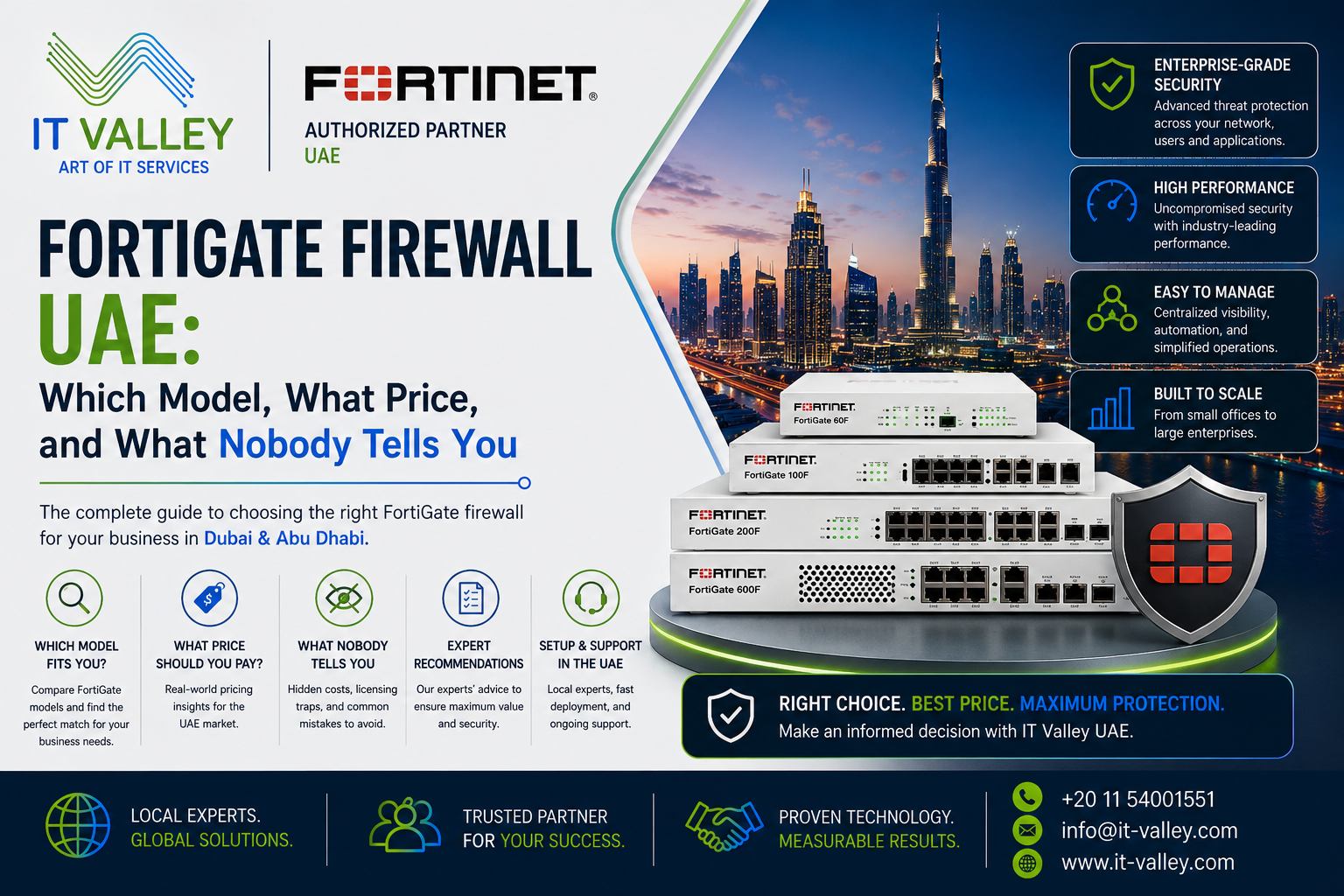
FortiGate Firewall UAE: Which Model, What Price, and What Nobody Tells You
FortiGate firewall UAE. If you typed that, you’re probably about to spend money on something that will either protect your network properly for the next few years — or become a recurring problem you didn’t budget for.
I’ll be straight with you. IT Valley is a certified Fortinet partner in UAE. We’ve put FortiGate into businesses across Dubai and Abu Dhabi, from small JLT offices to enterprise data centers in Abu Dhabi. We’ve also walked into networks where a FortiGate was already running and doing almost nothing useful.
Here’s what you actually need to know before you buy.
Get a FortiGate Quote in 24 Hours
Tell us your office size and user count. We’ll send back the right model and real pricing — same business day.
FortiGate vs. “Fortinet” — Why This Distinction Matters
People use both terms interchangeably. They’re not the same thing.
Fortinet is the company. FortiGate is the firewall. If someone quotes you “a Fortinet solution” without specifying the product, ask what you’re actually getting — because there are quite a few Fortinet products that aren’t firewalls.
FortiGate is a next-generation firewall. The practical difference from a traditional firewall is significant. Traditional firewalls check ports and IP addresses. FortiGate looks inside the traffic — what application is running, who the user is, whether the behavior looks normal. It detects threats inside encrypted sessions. That last part is the one that matters most right now, because the majority of network traffic is encrypted. A firewall that can’t inspect encrypted traffic is essentially looking at the outside of a sealed envelope and calling it mail inspection.
Everything runs on FortiOS — one operating system, every FortiGate model. Your Dubai branch office and your Abu Dhabi data center use the same interface, same policies, same management tools. For anyone managing more than one location, that consistency saves real time every week.
Which FortiGate Model Actually Fits Your Business
Most buyers get this wrong. Usually not their fault — they were quoted whatever was in stock or whatever had the best margin for the reseller.
FortiGate 40F — Small Offices and Branches
Under 50 users. Single location. Nothing complicated.
The 40F delivers full next-generation firewall protection without requiring a dedicated security person to keep it running. SSL inspection, application control, intrusion prevention, web filtering — all there. It works well for a retail outlet, a small professional services firm, or a branch office in Dubai or Sharjah.
One honest caveat: if you’re at 40 users and growing fast, start the 60F conversation now. Migrating under pressure six months from now costs more than getting the right device upfront.
FortiGate 60F — The One We Deploy Most Often
50 to 200 users. Growing businesses. Organizations with compliance requirements.
This is the model IT Valley deploys most frequently for UAE mid-market clients, and the reason is simple — it handles realistic workloads at 10 Gbps throughput without the cost jump to the 100F tier. It also has the logging and segmentation capabilities that CBUAE and DIFC frameworks specifically look for. If you’re a financial services firm, a healthcare provider, or any business that’s had an auditor ask about network controls, the 60F is usually where you land.
The most common mistake we see: buying the 100F because it “feels safer” and then running at 20% capacity for three years. The 60F handles most UAE mid-market workloads comfortably. We’ll tell you honestly if yours is an exception.
FortiGate 100F — When the 60F Ceiling Becomes Visible
200+ users. Multi-site enterprises. High-volume encrypted traffic inspection.
The 100F runs at 20 Gbps with proper high-availability clustering. It’s the right device for UAE enterprises managing multiple regional branches, organizations with dense SSL inspection requirements, and data center perimeter deployments.
It’s also where configuration complexity goes up meaningfully. A 100F with default settings is not delivering 100F value. This is where choosing the right partner matters more than the hardware decision itself.
Not Sure Which Model Fits?
Tell us your user count, number of sites, and internet speed. We’ll give you a straight answer — no upsell, no pressure.
The Part Nobody Tells You Before the Sale
Buying FortiGate hardware and plugging it in gets you maybe 30% of what it can do. The other 70% is configuration — and getting it wrong doesn’t just mean leaving features unused. It means leaving your network exposed while thinking you’re protected.
SSL inspection is the biggest gap we find. If it’s not configured correctly, encrypted threats pass straight through the firewall without triggering anything. Most modern attacks use HTTPS. A FortiGate with SSL inspection misconfigured is not inspecting the majority of your threat surface.
Security profiles need tuning to your actual traffic patterns. Application control, web filtering, and intrusion prevention all have defaults that work generically — not for your specific environment, your specific users, your specific applications.
Logging has to be structured from day one. When a CBUAE or DIFC examiner asks for audit logs, discovering they were never configured properly is not a good moment.
We’ve walked into UAE environments where FortiGate hardware was running for months doing a fraction of what it should have been. The business thought they were protected. They weren’t.
IT Valley configures every FortiGate deployment properly from the start — policy architecture, SSL inspection, compliance logging, everything. We also document what we did and why, so your team actually understands the environment they’re running.
FortiGate and UAE Compliance
CBUAE: FortiGate segmentation and FortiAnalyzer logging directly support Central Bank examination requirements. We configure log formats to match what CBUAE examiners actually ask for — not what’s easiest to produce.
DIFC Cybersecurity Framework: Application-aware firewall policies and FortiGate’s distributed firewall capabilities address DIFC network isolation requirements directly. For DIFC-regulated firms that also need endpoint controls, FortiEDR extends protection to individual devices.
UAE IA Standard: IT Valley maintains hardening templates aligned with UAE IA baseline controls. Government and quasi-government entities meet IA requirements from day one — not as a retrofit before an audit.
OT Security: For UAE industrial environments — oil and gas, utilities, manufacturing — FortiGate ruggedized appliances handle IT and OT network segmentation with deep packet inspection for industrial protocols. Standard IT firewalls can’t do this. Our network security services cover OT/IT convergence for UAE industrial clients specifically.
FortiGate vs. The Alternatives — Honest Version
Sophos XGS is a legitimate alternative for UAE SMEs that find FortiGate’s feature set more than they need. Similar price range, simpler management. IT Valley works with both — we’ll tell you which fits your situation.
Cisco ASA/Firepower has a large UAE installed base. The migration from ASA to Firepower hasn’t been seamless for many organizations, and the pricing model is less favorable than FortiGate at comparable performance levels. If you’re inheriting a Cisco environment, that’s a different conversation than building from scratch.
pfSense/OPNsense come up in cost-sensitive situations. Genuinely capable in the right hands — but “in the right hands” is carrying significant weight in that sentence. For UAE organizations with compliance requirements, the support and audit documentation story is weak.
FortiGate’s advantage is the combination: price-to-performance, unified FortiOS across all form factors, and FortiGuard threat intelligence updating every deployed device in real time. For most UAE enterprise environments, that’s hard to match at comparable cost.
FAQ: FortiGate Firewall UAE
What’s the real difference between 40F, 60F, and 100F for UAE businesses?
Roughly: 40F under 50 users, 60F for 50–200 users with compliance requirements, 100F for larger enterprises with high-throughput or HA needs. The honest answer depends on your actual traffic volume and SSL inspection requirements. We size this against your real environment before recommending anything.
Is IT Valley a certified FortiGate partner in UAE?
Yes. Certified Fortinet partner, NSE-certified engineers, serving Dubai, Abu Dhabi, and every UAE emirate. Genuine hardware, official licensing, Fortinet-backed support.
What does FortiGate actually cost in UAE?
Depends on the model and licensing tier. A 40F with basic FortiCare costs a fraction of a 100F enterprise deployment. Send us your requirements and we’ll give you real numbers — not a vague starting-from range.
How long does a FortiGate deployment take in UAE?
One to three weeks for standard deployments. You get a confirmed timeline and project plan before any work starts.
Does FortiGate help with OT security requirements in UAE?
Yes. Ruggedized FortiGate appliances with deep packet inspection for industrial protocols cover IT/OT segmentation requirements that standard firewalls can’t handle. For UAE oil and gas, utilities, and manufacturing environments, this is one of the more important security controls to get right.
What happens if I already have a FortiGate that isn’t configured properly?
We do a configuration review, tell you what’s actually working and what isn’t, and fix what needs fixing. It’s more common than you’d think, and the remediation is usually faster than a fresh deployment.
Get Your FortiGate UAE Quote Today
You know enough now to make a good decision. Tell us your environment — office size, user count, number of sites, any compliance requirements — and we’ll come back with the right model and real pricing, same business day.