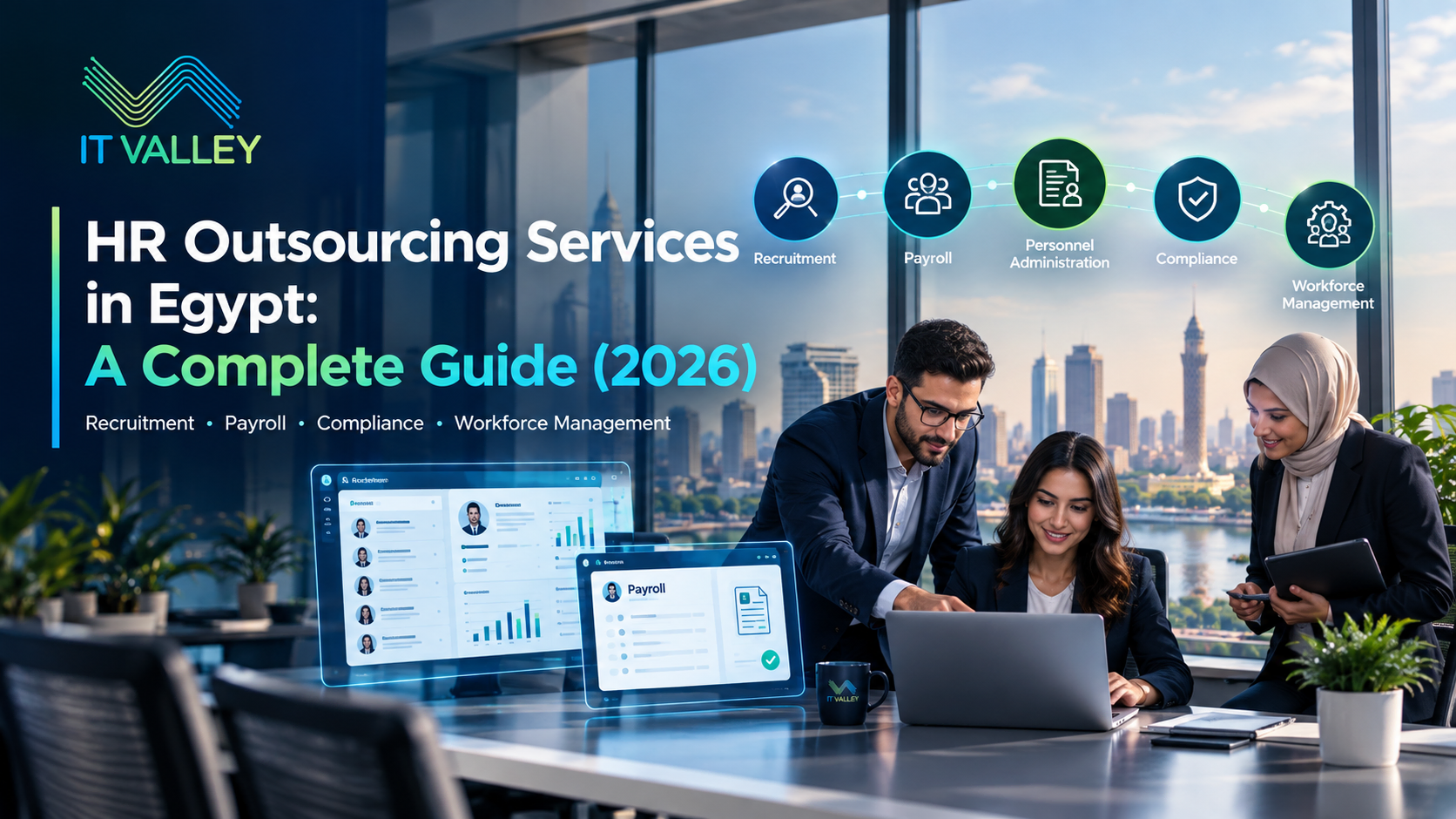
HR Outsourcing Services in Egypt: A Complete Guide (2026)
HR outsourcing services in Egypt mean handing part of your people work, usually payroll, hiring and paperwork, to an outside company that does it all day, every day. If you run a business with 30 or 300 employees and your one HR person is buried under insurance forms and attendance sheets, you’re probably reading this for a reason. Below IT Valley will tell you what you get, roughly what it costs, where it goes wrong, and how to pick a provider you won’t regret.
What HR outsourcing covers?
It’s not all or nothing. Some companies only outsource payroll and keep everything else in-house. Others hand over almost the whole routine side of HR and keep only the decisions that shape the culture: who to promote, how to pay, what the rules are.
You’ll see providers described as HR outsourcing companies, managed HR services, or PEOs. The labels vary. What matters is the list of tasks they will really do for you, and who is accountable when something goes wrong.
Why Egyptian companies are doing it?
Most of the time it comes to a few plain problems.
Payroll in Egypt is not just salaries. You deal with social insurance, income tax, overtime, deductions, and contracts that must match the law. One wrong number and an employee notices on payday, or an auditor notices a year later.
Growth is the second reason. Hiring 40 people in three months is a full-time job on its own, and a small HR team can’t do that and run the company at the same time and that’s why IT Valley wants to do it for you.
There are foreign companies opening an office here, They usually want someone local who already knows how things work, instead of learning it the hard way.
The services people buy most
Payroll. By far the most outsourced piece. The provider calculates pay, insurance and tax, sends pay slips, and prepares the bank file. You approve, they run it.
Recruitment. Anything from posting jobs and scanning CVs to running the whole hiring process for you. Pricing is usually per hire.
Onboarding and employee records. Contracts, personnel files, insurance registration, leave, exits. Boring, but this is where audits find problems.
Compliance support. Keeping your contracts and policies in line with Egyptian labor and social insurance rules, and flagging changes before they catch you out.
Benefits and compensation. Medical insurance coordination, salary benchmarking, and basic benefits administration.
What do you gain?
Cost is the obvious win for your company. Choosing a specialist team like IT Valley across many clients is usually cheaper than building your own, especially for companies with up to a few hundred employees.
You also make fewer mistakes, since people who run payroll for dozens of companies have seen most of the edge cases. And your own HR person finally gets time for the work that moves the business, like keeping good people and training managers.
One more thing people don’t expect: cleaner data. When records live in one system instead of five spreadsheets, you can finally answer simple questions like how many people left this year.
What can go wrong?
Being honest here saves you money later.
You lose some day-to-day control. If the service levels aren’t written down, “we’ll get back to you” can mean three days. Employee data also leaves your building, so the contract has to say who can see it and how it’s protected. And if the provider talks to your staff, make sure they sound like your company and not like a call center script.
The last risk is lock-in. Before you sign, find out how you get your data back if you leave.
None of this is a reason to avoid outsourcing, in fact it’s a reason to read the contract carefully.
What does it cost?
There isn’t a single price, and anyone who quotes you one before asking about your headcount is guessing. The common models are:
• A monthly fee per employee, typical for payroll and admin
• A fixed monthly retainer for ongoing support
• A fee per hire, or a percentage of the annual salary, for recruitment
• A one-off project price for things like an HR audit or a new policy handbook
What moves the number: how many employees, how many sites, how complicated your pay rules are, and which tools the provider uses. Make sure to ask three providers for itemized quotes and compare what’s included, not just the total. The cheapest quote often leaves out the thing you need
Is it the right time for you?
It probably is if you recognize two or more of these:
1. Payroll mistakes or late payments keep happening
2. You’re hiring fast and can’t keep up
3. One person does all of HR, or nobody does
4. You’re a foreign company setting up in Egypt
5. A labor inspection or audit worries you
6. Your HR team spends its week on paperwork
If you have 8 employees and a simple payroll, you might not need it yet. A good accountant and a simple HR system may be enough.
Questions to ask before you pick a provider
Skip the sales deck and ask for these in the meeting:
• How do you stay current on Egyptian labor and social insurance changes? Ask for a recent example.
• Can I talk to two clients of a similar size and industry?
• Which system do you run payroll on, and can it connect to our accounting or ERP?
• Where is our employee data stored, and who has access?
• What happens if payroll is late or wrong? Is that in the contract?
• What exactly is included, and what costs extra?
• If we leave, how do we get our data back and how long does it take?
• Do you support us in Arabic and English, and will we have one named contact?
A good provider answers these without hesitation. A vague answer to the data and exit questions is a red flag.
Where technology fits in
Most outsourcing problems aren’t really people’s problems. They’re data problems: the attendance device doesn’t talk to payroll, payroll doesn’t talk to finance, and somebody retypes numbers every month. That’s where mistakes sneak in.
So, before you sign with anyone, look at the systems underneath: secure networks, cloud hosting, user access, and how HR tools connect to your finance and ERP software. This is the part IT Valley works on as a system integrator across Egypt, the UAE and KSA, and it matters whether your HR runs in-house or with a partner.
A simple way to start
List what’s slow, risky or expensive in your HR work right now. Decide what you’d hand over and what you’d keep. Shortlist three providers, run one payroll cycle in parallel with your current process, and only then sign. After that, review it every quarter using numbers you agreed on up front, such as payroll accuracy and time to hire.
Quick answers
What does HR outsourcing include?
Payroll, recruitment, onboarding, employee records, benefits administration, compliance support and reporting. You choose which parts.
Is it only for big companies?
No. Smaller, fast-growing companies often get the most out of it, because they get proper processes without hiring a full team.
Is outsourced payroll safe?
It can be, if the provider controls access, encrypts data and signs a clear confidentiality clause. Ask to see how they do it.
How long does setup take?
Payroll alone can start within a few weeks. Full-service outsourcing takes longer because your data and processes have to be moved over. It depends on the provider and how ready your records are.
Will I lose control of HR?
Not if you set it up properly. You keep the decisions on policy and people. The provider does the routine work under agreed service levels.
Final thoughts
Outsourcing HR won’t fix a company with unclear roles or unhappy managers. What it does well is take repetitive, high-risk admin off your plate so mistakes drop and your team can think. Start small, test it on one function like payroll, and expand only if it works.
If your HR and finance systems need to talk to each other properly before you outsource, get in touch with the IT Valley team to explore the right outsourcing solution for your business
For more information about IT Valley’s Outsourcing services and how they can support your business contact our team