Welcome to IT Valley, your trusted systems integration partner.

Contacts

IT Outsourcing Egypt – Cut Costs Without Cutting Quality

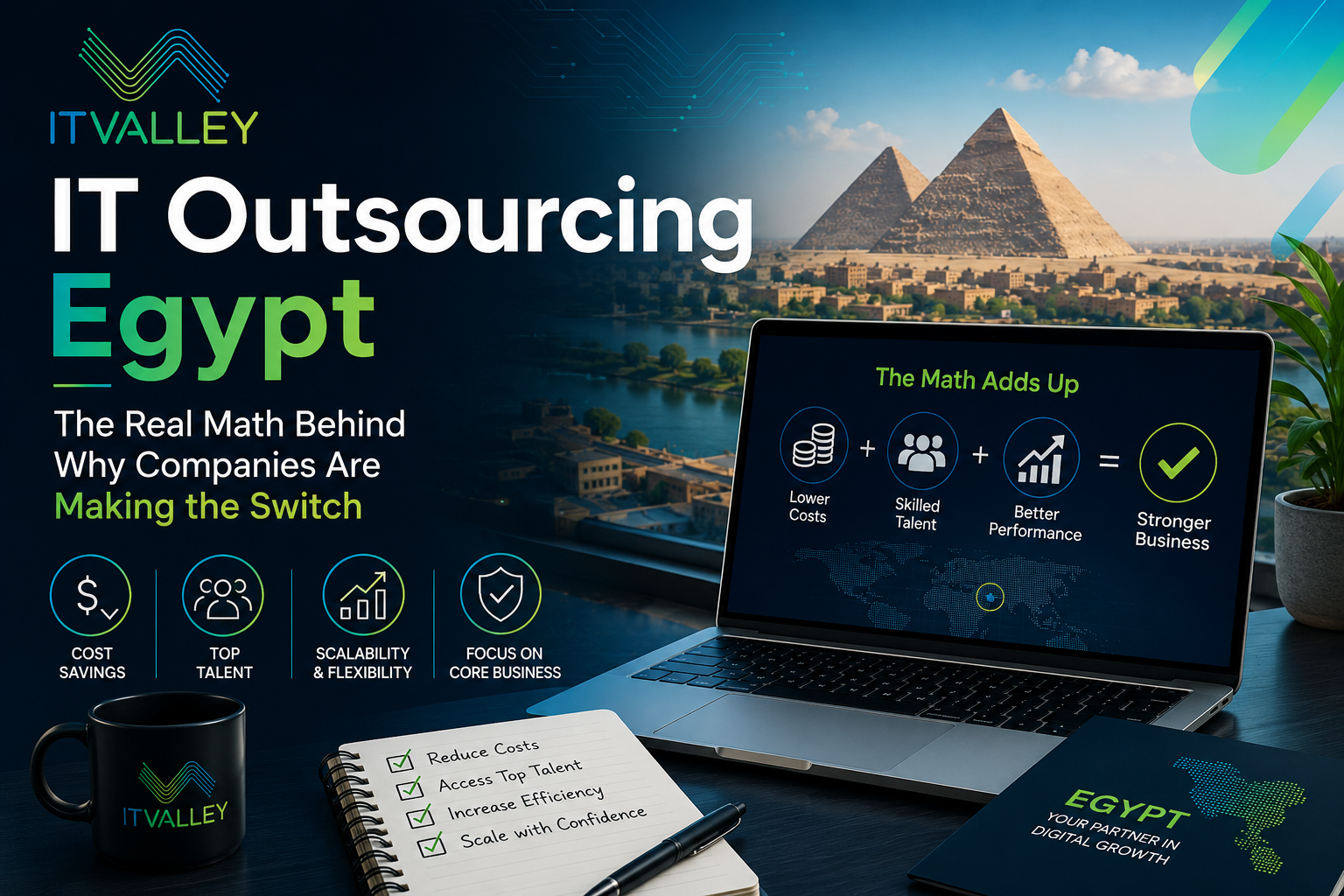
IT Outsourcing Egypt – The Real Math Behind Why Companies Are Making the Switch

IT outsourcing Egypt searches have been climbing. Fast. And once you look at the numbers, it’s not hard to see why. A full in-house IT team in Cairo costs more than most business owners budget for. Salaries. Benefits. Training. Equipment. Turnover. Add it all up and it’s a lot. And half the time, that team sits idle for weeks, then drowns during a crisis. We’ve sat with finance directors across Cairo who reached the same conclusion, almost word for word: the in-house model wasn’t broken because of bad hires. It was broken because IT work doesn’t arrive on a steady schedule. It spikes during a migration. Goes quiet for a month. Spikes again during a security incident nobody saw coming. Outsourcing fixes that mismatch. Not just because it’s cheaper — though usually it is. But because you start paying for capacity that actually flexes with what you need. This isn’t the generic version of that pitch. Let’s get into it properly.  

Why Egypt, Specifically

This isn’t just something we say to sound good. Egypt’s outsourcing sector has grown significantly over the past fiscal year. There are real reasons behind that. A large pool of skilled, English-speaking graduates comes out of Egyptian universities every year. Labor costs sit well below Western Europe or the Gulf — but skill levels are genuinely competitive, not a discount version. Time zones overlap with Europe and the Middle East, so real-time collaboration is actually practical, not theoretical. And the government has been investing in the sector. Tax incentives. Dedicated tech zones. Infrastructure upgrades. Cairo isn’t just where outsourcing happens cheap. It’s becoming where it happens well.  

Three Models. Pick the Wrong One and the Whole Thing Falls Apart

Most outsourcing conversations jump straight to price. That’s backwards. Model matters more. Project-based outsourcing. You have a defined deliverable — a migration, a new system, an infrastructure rollout. A team comes in, delivers, the engagement ends. Works well when scope is clear and there’s a real finish line. Staff augmentation. You need specific skills you don’t have internally. But you still want control over how the work actually happens day to day. We embed engineers into your existing workflow instead of handing you a finished black box. Managed services. This is the one most businesses end up wanting, once they understand what it actually means. Instead of hiring an internal helpdesk or infrastructure team, an outsourced team handles monitoring, support, and maintenance continuously. With an SLA that spells out exactly what response time you’re getting. In writing. Here’s the most common failure we see: a company needed managed services, signed a project contract instead, the project ended, and six months later they’re right back where they started. Wrong model. Same problem.  

What Actually Separates a Good Outsourcing Company From a Bad One

Anyone can say “cost savings” and “skilled engineers.” Here’s what we’d actually check, based on what we’ve seen go wrong with other vendors before clients came to us. Response time, written down. Not implied. If the SLA doesn’t list exact response and resolution times by severity level, you don’t have an SLA. You have a hope. Ask for the number. If they hesitate, that tells you something. Engineers who stick around. High turnover on their side means you keep re-explaining your setup to someone new. Ask how long their average engineer has stayed. A vendor with constant internal churn will eventually hand that instability to you. Communication that doesn’t need translating in your head. Sounds minor. Isn’t. Try explaining a production issue at 11pm through a language gap and you’ll feel the difference fast. Real Arabic and English fluency — not a line on a brochure. Documentation. Not memory. A good partner writes down your infrastructure, your history, your recurring issues. So the knowledge lives in a system. Not in one engineer’s head who might quit next month. Scalability without a fight every time. Your needs in month three shouldn’t trigger a renegotiation. Build flexibility in from day one, or don’t sign.  

Where the Savings Are Real — and Where They’re Not

We’d rather be straight with you. A lot of outsourcing pitches oversell this part. You will save on salary overhead. Benefits. Training. Recruitment time. Equipment. You’ll also save on paying someone full-time during the slow weeks when there isn’t enough work to justify it. You won’t magically save money if you outsource the wrong scope. Or sign with a vendor who doesn’t understand your industry. Or treat the whole thing as “set it and forget it” with zero oversight on your end. Outsourcing reduces cost. It doesn’t remove your job of managing the relationship. The honest number for most mid-sized Cairo businesses: a properly scoped outsourcing setup usually cuts total IT spend by a meaningful margin versus an equivalent in-house team — and it cuts your management headache too.  

Where This Makes the Most Sense Right Now in Egypt

Retail and e-commerce. Seasonal spikes. POS uptime. Inventory integrations. Workloads that genuinely swing up and down — not enough to justify a big permanent team. Financial services. Compliance pressure, security monitoring, uptime demands. You need real expertise here. Building it in-house from scratch is slow and expensive. Manufacturing. ERP support across multiple sites. Specialized technical help that’s hard to justify hiring full-time for just one facility. Startups and growing SMEs. The case we see most. A company needs enterprise-grade IT support but doesn’t have the budget or the hiring pipeline to build a full department yet.  

Why Businesses in Egypt Choose IT Valley

We run dedicated IT outsourcing services and outsourcing and offshoring solutions for companies across Egypt — covering everything from short project work to fully managed long-term support. We’re based in Cairo. Our engineers are local. When something needs a fast response, you’re not waiting on a time zone difference or routed through an offshore call center that’s never seen your environment. We document everything. We keep engineer turnover low, on purpose. And our SLAs have real numbers in them. Not vague language about “prompt response.” If you’ve worked with an outsourcing vendor before and it didn’t go well — it was probably one of the issues above. We built our process specifically to close those gaps.  

Frequently Asked Questions

How is this different from just hiring freelancers? Freelancers work alone. Often no backup, no documentation standards, no real accountability. An outsourcing company gives you a team, defined SLAs, continuity if someone leaves, and one point of contact who’s accountable for results. What’s the minimum commitment? Depends on the model. Project work has a natural end tied to the deliverable. Managed services usually run on renewable terms. We don’t lock clients into long contracts that don’t make sense for them. Does this work for small businesses, or only big enterprises? Small businesses often benefit the most. That’s usually where the gap between in-house and outsourced cost is biggest — a small company can’t fully use a full-time hire the way a larger one can. How fast can a team start? Depends on scope. Staff augmentation can sometimes start within days. Larger managed service setups need a short onboarding period first, to document your environment properly before support kicks in. What if we’re not happy with how it’s going? That conversation needs to happen before signing, not after. Ask any vendor about exit terms and SLA penalties upfront. We’re upfront about ours from the first call.  

The Real Question

It’s not “should we outsource IT.” It’s “does our current setup actually match our workload — or are we paying for capacity we don’t use, and still short on the capacity we actually need.” If you’re not sure, that’s worth a five-minute conversation. IT Valley has been doing this in Egypt long enough to give you a straight answer either way.