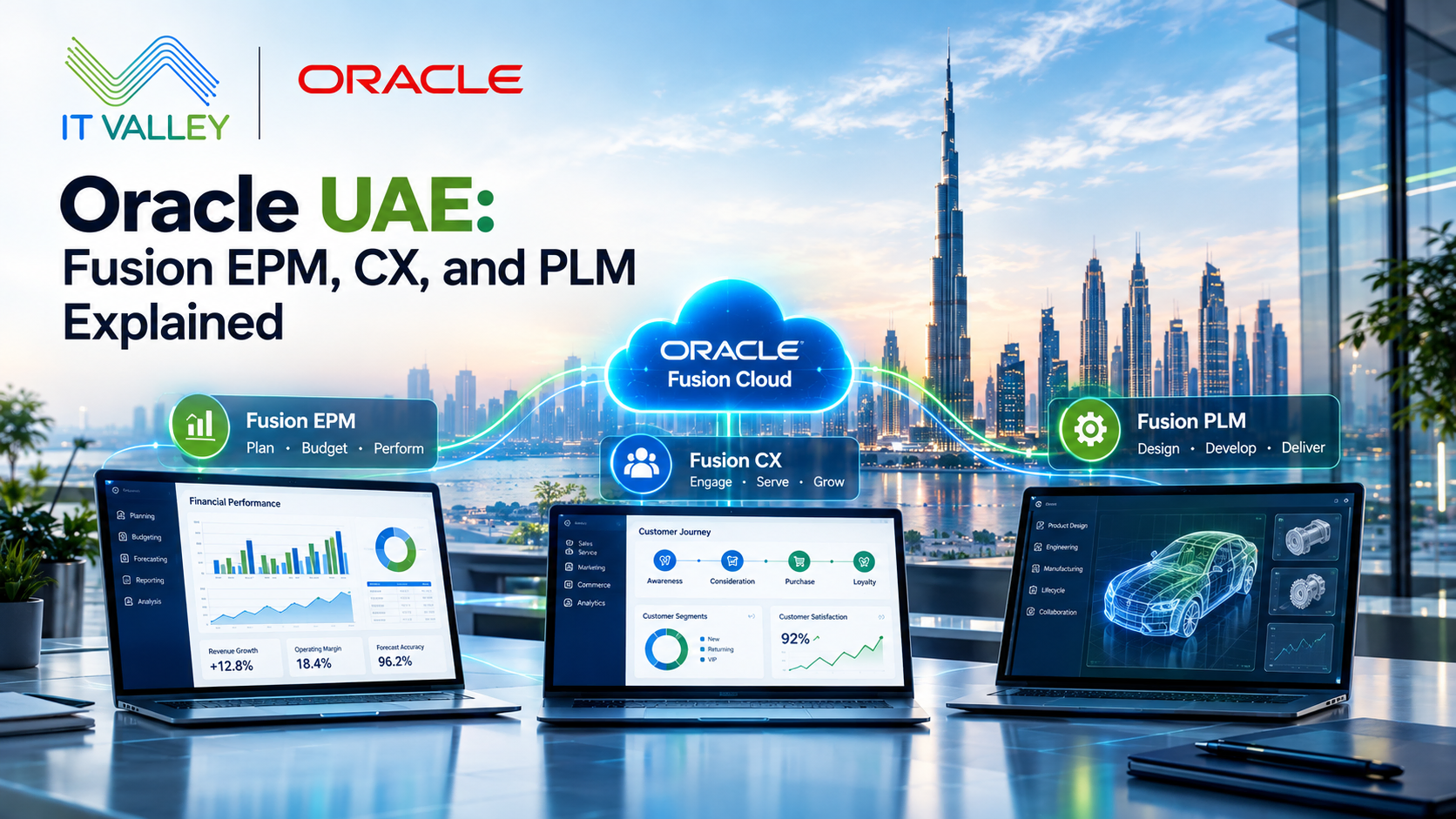
Oracle UAE: Fusion EPM, CX, and PLM Explained
Oracle UAE conversations usually start with ERP. Finance, procurement, supply chain. But Oracle Fusion Cloud covers a lot more ground than the core ERP suite. Three modules in particular come up again and again with UAE clients. EPM, CX, and PLM. Each one solves a different problem, and most businesses only need one or two of them.
IT Valley is an Oracle certified partner serving Dubai and Abu Dhabi. For the full picture of what we deliver, see our Oracle Partner UAE page. This post goes deeper into these three modules. What each one actually does, and who should care.
Why the Module Choice Matters More Than the Brand
Oracle Fusion Cloud isn’t one product. It’s a family of apps that share a common data model. You can start with finance and add other modules later. Or start somewhere else entirely. The order you pick matters.
A common mistake we see is buying everything at once because the bundle looks efficient. Then half the modules sit unused for a year while the team struggles with the rest. Starting with the one module that solves your biggest problem is almost always smarter.
Oracle Fusion EPM: Planning, Budgeting, and Closing the Books
EPM stands for Enterprise Performance Management. In plain terms, it’s the tool finance teams use to plan, forecast, and report. Think annual budgets, mid-year reforecasts, and the monthly close process where every department’s numbers get pulled into one set of financial statements.
Many UAE finance teams still run this in spreadsheets. It works until it doesn’t. A budget file passes through six people, someone overwrites a formula, and nobody notices until a board meeting. EPM replaces that chaos with one controlled system. Everyone works from the same numbers, with a clear record of who changed what.
It also speeds up the financial close. EPM can combine results across several companies and currencies. That matters a lot for UAE groups with subsidiaries in Dubai, Abu Dhabi, and across the GCC. Closing the books can drop from weeks to days, once the manual matching work gets automated.
Who Should Look at EPM First
EPM fits best when finance is your biggest pain point. A few signs it’s the right starting module. Budgeting takes months and still turns out wrong. Your group has several legal entities and consolidating them is painful. Auditors keep flagging spreadsheet risks.
If those sound familiar, EPM often delivers faster results than a full ERP rollout. It also connects to non-Oracle systems, so you don’t need Oracle ERP already running to benefit from it.
Oracle Fusion CX: One View of Every Customer
CX stands for Customer Experience. It covers sales, marketing, and service tools in one connected platform. The core idea is simple. Every team that talks to a customer should see the same history.
Picture a UAE real estate group. Marketing runs a campaign. Sales follows up on leads. Service handles complaints after a sale. In many companies, those three teams use three different systems. A customer calls support, and the agent has no idea they just signed a contract last week. CX fixes that by putting everything in one place.
For UAE businesses, this matters more than it might seem. Customer expectations here are high, especially in retail, hospitality, and property. A slow or disconnected response costs sales. CX gives teams the context to respond quickly, and it gives managers real data on what’s working.
Who Should Look at CX First
CX makes the most sense for businesses with large customer bases and multiple customer-facing teams. Retail groups, real estate developers, banks, and telecom providers are common fits. If your sales pipeline lives in spreadsheets, or your service team can’t see sales notes, that’s a clear sign.
It’s less urgent for businesses with few, high-value clients and a small team. A lighter tool may do the job there. We help clients figure that out honestly before recommending a full rollout.
Oracle Fusion PLM: From Product Idea to Market
PLM stands for Product Lifecycle Management. It tracks a product from first idea through design, testing, launch, and eventual retirement. All the specs, drawings, supplier details, and change requests live in one system.
This sounds niche, but it solves a real problem for manufacturers and product companies. Without PLM, product data gets scattered. An engineer changes a design, but the purchasing team still orders parts to the old spec. The result is waste, delays, and sometimes defective products reaching customers.
PLM stops that. Every change goes through an approval step. Everyone sees the current version. Quality issues trace back to their source fast. For UAE manufacturers, food producers, and industrial firms, that discipline protects both margins and reputation.
Who Should Look at PLM First
PLM matters most for firms that design or make physical products. Think manufacturing, food and drink, consumer goods, and heavy equipment. Do product changes cause chaos on the factory floor? Does compliance paperwork take weeks to pull together? Then PLM is worth a close look.
Service firms rarely need it. If you don’t develop products, skip this one. Not every Oracle module fits every company.
How the Three Modules Work Together
You don’t need to buy them together. But they do connect well when you eventually add a second or third. Sales data from CX flows into EPM, so forecasts reflect the real pipeline. Product costs from PLM feed into finance, so margins reflect what things actually cost to make.
This is the quiet advantage of staying inside one family. Data moves between modules without custom links to build and maintain. For UAE groups that grow over time, adding a module later usually takes less effort than starting a brand new, unrelated system.
Data Residency and UAE Compliance
Every Fusion project in the UAE has to answer one question early. Where does the data live? Oracle runs cloud regions in the Middle East, which helps businesses keep data inside the region. For banks, government bodies, and other regulated firms, that often decides which deployment option makes sense.
We map this out before any configuration begins. UAE VAT rules, local reporting needs, and residency requirements all shape the setup. Getting this wrong early means painful rework later, so we treat it as a first-week conversation, not a final checklist item.
How IT Valley Approaches Oracle Fusion Projects
Problem first, module second. We start with your biggest pain point, then pick the module that solves it.
Staged rollouts. One module goes live and settles in before the next begins.
Local compliance built in. Configuration aligned with UAE VAT, reporting, and data residency rules.
Ongoing support. Updates, training, and tuning continue well after go-live.
Frequently Asked Questions
Can we buy EPM without Oracle ERP? Yes. EPM works with many source systems, not just Oracle’s own ERP. Plenty of UAE companies run it on top of other finance platforms.
How long does a Fusion module rollout usually take? It varies by scope. A focused EPM planning project can go live in a few months. CX and PLM projects often run longer, depending on integrations and data cleanup.
Do we need all three modules? Almost never. Most UAE businesses need one, sometimes two. We only recommend what your operations really require.
Talk to IT Valley About Oracle Fusion
Not sure which Oracle Fusion module fits your business? Get in touch with IT Valley’s certified Oracle engineers for a straight assessment of what you actually need, and what you can safely skip.