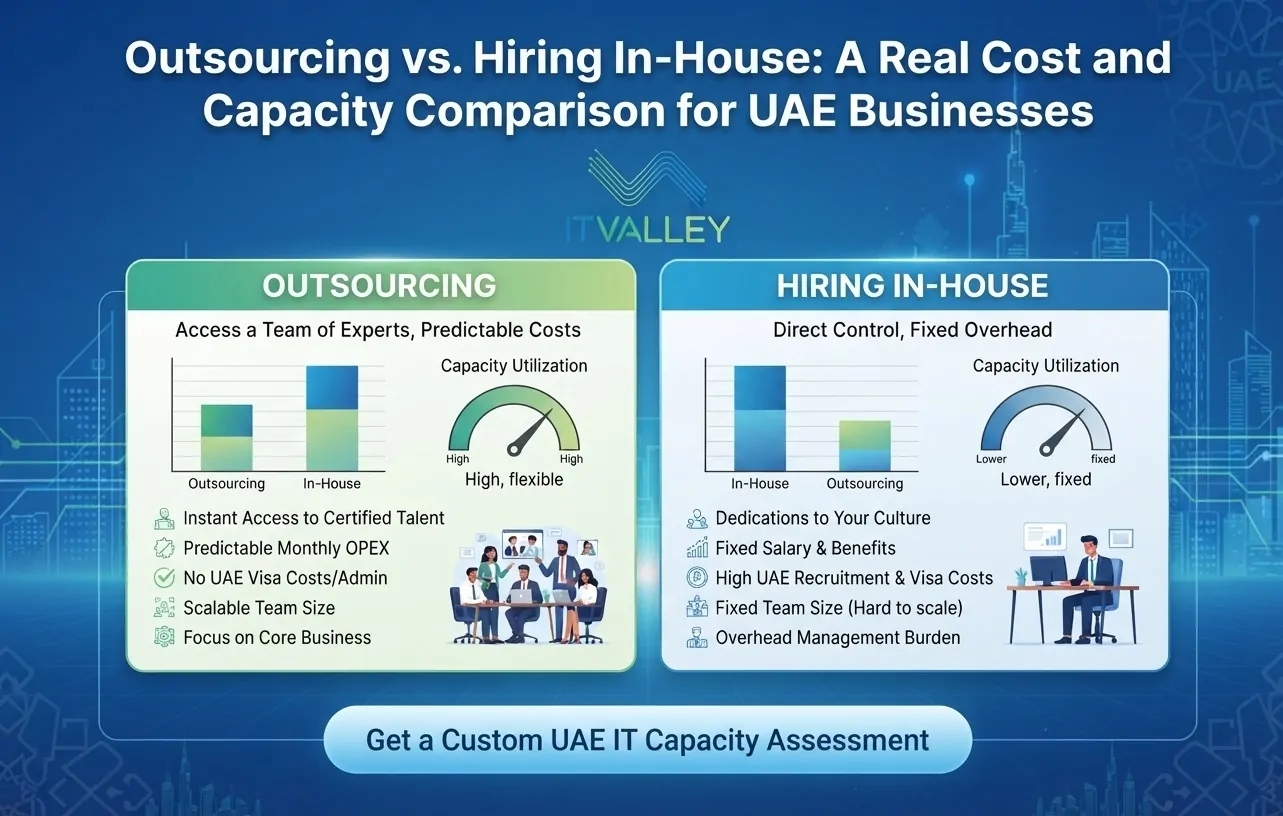
Outsourcing vs. Hiring In-House: A Real Cost and Capacity Comparison for UAE Businesses
Every growing Dubai business reaches the same decision point eventually. The IT team is stretched. HR is behind. Customer service is inconsistent. Something has to change.
Two options sit on the table. Hire internally. Or outsource.
Both get presented as straightforward decisions. Neither actually is. The real comparison — when you account for total cost, operational risk, and capacity flexibility — looks very different from the headline numbers. This article walks through that comparison honestly, for UAE businesses specifically, where the cost of hiring and the complexity of HR compliance add dimensions that make the decision more nuanced than it appears anywhere else in the region.
The Cost Comparison Nobody Does Correctly
Most businesses compare outsourcing to a salary. That’s the wrong comparison.
The actual cost of an in-house hire in UAE includes salary, yes. But it also includes visa costs, medical insurance, end-of-service gratuity accruals, recruitment fees, onboarding time, equipment, office space, and the management overhead of having an additional direct report. Add the probability of turnover — UAE’s competitive job market makes staff retention genuinely difficult — and the cost of replacing someone every 18 to 24 months, and the real per-year cost of an in-house IT support engineer in Dubai is meaningfully higher than the salary figure.
Outsourcing, by contrast, is a fixed monthly cost. No visa processing delays. No recruitment fees. No equipment costs. No end-of-service liability building on the balance sheet. And critically, no coverage gap when the person is sick, on leave, or has decided to take a better offer from a competitor.
The comparison isn’t outsourcing cost versus salary. It’s outsourcing cost versus total employment cost including all the variables that HR departments know about but finance departments sometimes don’t see clearly until the end of a financial year.
The Capacity Argument — Where In-House Consistently Loses
One person can do one job at a time. That’s obvious. What’s less obvious is how often growing Dubai businesses discover that the job they hired for has changed by the time the person is in seat.
A Dubai enterprise that hires an IT support engineer to manage helpdesk discovers six months later that they also need someone who can manage their cloud environment, review security configurations, and handle vendor relationships. These are different skill sets. The person they hired for helpdesk either stretches to cover everything inadequately, or the business hires a second person, or specific requirements go unaddressed.
Outsourcing a managed IT service gives access to a team with multiple specialisations rather than a single generalist. When a network issue requires a different skill set than a server problem, the outsourcing team covers both. When the requirement changes — new technology, new compliance obligation, new project — the service adapts without a new recruitment cycle.
That flexibility has genuine value for growing UAE businesses. The cost of a recruitment cycle — typically two to four months from decision to productive hire in Dubai — is significant when measured against a business need that exists right now.
The Compliance Reality for UAE Employers
This is the dimension of in-house hiring that gets least attention and causes the most unexpected problems.
UAE employment law, WPS payroll compliance, MOHRE documentation requirements, end-of-service calculation, and visa processing are non-trivial administrative obligations. For a Dubai SME that hires its first few employees outside its core business function — an IT person, an HR administrator — compliance management becomes a distraction from the actual business.
The stakes are also real. Late WPS payments carry fines. Incorrect end-of-service calculations create legal exposure. Visa status errors create situations that are expensive and time-consuming to resolve. These aren’t hypothetical risks — they’re the compliance issues that UAE businesses deal with regularly when internal HR capacity doesn’t keep pace with headcount growth.
Outsourcing transfers that compliance burden to a provider whose core business is managing it correctly. For UAE businesses that want to grow their operational capacity without growing their compliance exposure proportionally, outsourcing functions with complex employment implications is often the cleaner path.
When In-House Is Actually the Right Answer
This article would be dishonest if it only made the case for outsourcing.
In-house hiring is the right choice when the role requires deep, specific institutional knowledge that can only be built over time within the organisation. When cultural alignment and stakeholder relationships are central to the function’s success. When the work involves strategic decisions that shouldn’t be delegated to an external provider. And when the organisation has the HR infrastructure to manage the employment relationship properly.
For senior IT leadership — a CTO, a Head of Infrastructure, a Security Director — in-house hiring typically makes more sense than outsourcing. These roles shape direction rather than execute tasks, and the institutional knowledge and relationship-building they require are hard to replicate through a service engagement.
The decision isn’t binary across the whole organisation either. Many UAE businesses run a hybrid model — senior IT leadership in-house, execution-layer IT support outsourced. Strategic HR decisions managed internally, payroll and compliance outsourced. This captures the institutional knowledge and cultural alignment benefits of in-house hiring where they matter most, while removing the operational overhead of functions where consistent execution matters more than internal ownership.
The Hidden Cost That Decides Most Comparisons
There’s one cost that rarely appears in the analysis but consistently determines which option is actually better: the cost of getting it wrong.
A bad in-house hire in Dubai costs the recruitment fee, the visa processing cost, several months of salary while performance issues become clear, and then the redundancy process — which in UAE carries specific legal requirements and costs. The timeline from “this isn’t working” to “this person has left and we’re recruiting again” is typically six to nine months.
A poorly structured outsourcing engagement costs less dramatically and is faster to exit. Most outsourcing contracts in UAE have notice periods measured in weeks rather than months, with no end-of-service liability and no legal process to manage.
For growing Dubai businesses making decisions under uncertainty — not fully sure what the role needs to look like in 12 months, not fully sure how much capacity they need — outsourcing reduces the cost of being wrong. That optionality has real value even when the total cost of outsourcing and in-house hiring were exactly equal, which they rarely are.
A Practical Framework for the Decision
Rather than a general recommendation, here’s a framework that works for most UAE businesses.
Outsource when: the function is execution-focused rather than strategic, specialised skills are needed across a broader range than one hire provides, compliance management would distract internal management, or growth pace means requirements may change before a hire is productive.
Hire in-house when: the role requires deep institutional knowledge, stakeholder relationships are central to the function, strategic direction is part of the responsibility, or the organisation has the HR infrastructure to manage the employment relationship properly at scale.
Consider the hybrid model when: some aspects of the function need internal ownership and others need specialist execution. Senior IT leadership in-house, managed services for infrastructure. HR business partnering in-house, payroll and compliance outsourced.
For most growing Dubai businesses, the honest answer is that the hybrid model captures more value than either extreme — and that the right split depends on the specific function, the current stage of growth, and the internal capacity to manage relationships with external providers.
FAQ: Outsourcing vs In-House UAE
Is outsourcing IT cheaper than hiring in-house in UAE?
When total employment cost is compared to outsourcing cost — including visa fees, medical insurance, end-of-service gratuity, recruitment costs, equipment, and management overhead — outsourcing is typically cheaper for execution-layer IT functions. The comparison shifts for senior strategic roles where institutional knowledge and relationship-building are central to the function.
What functions do Dubai businesses most commonly outsource?
IT helpdesk and managed services, HR administration and payroll, customer service and contact center operations, NOC monitoring, and finance and accounting functions. These are all execution-focused, compliance-intensive, or specialisation-broad enough that outsourcing delivers consistent operational advantages over in-house hiring.
How long does it take to start an outsourcing engagement vs completing a hire in UAE?
An outsourcing engagement with IT Valley typically starts within two to three weeks of contract signing. A Dubai hire — from job posting to productive employee — typically takes two to four months, accounting for recruitment, interview process, offer acceptance, visa processing, and onboarding. The capacity gap during that period has real operational cost.
What are the risks of outsourcing IT in UAE?
The primary risks are quality inconsistency, knowledge transfer gaps when provider teams change, and dependency on an external provider for functions that become business-critical. IT Valley mitigates these through documented run-books maintained for every client environment, defined SLA performance reporting, and structured exit provisions that ensure clean knowledge transfer.
Can Dubai businesses outsource some functions and hire internally for others?
Yes — and for most growing UAE businesses, this hybrid model captures more value than either extreme. Senior IT leadership and strategic roles are typically better served by in-house hiring. Execution-layer IT support, payroll compliance, and customer service operations typically deliver better outcomes when outsourced to a specialist provider.
Talk to IT Valley About the Right Model for Your UAE Business
IT Valley provides IT outsourcing, HR outsourcing, and managed services for UAE businesses across Dubai and Abu Dhabi. We’ve also had the conversation about whether outsourcing makes sense often enough to give you an honest answer rather than a pitch.
Tell us what you’re trying to build or fix. We’ll tell you whether outsourcing is the right answer for your specific situation — and if it is, what it would actually look like.