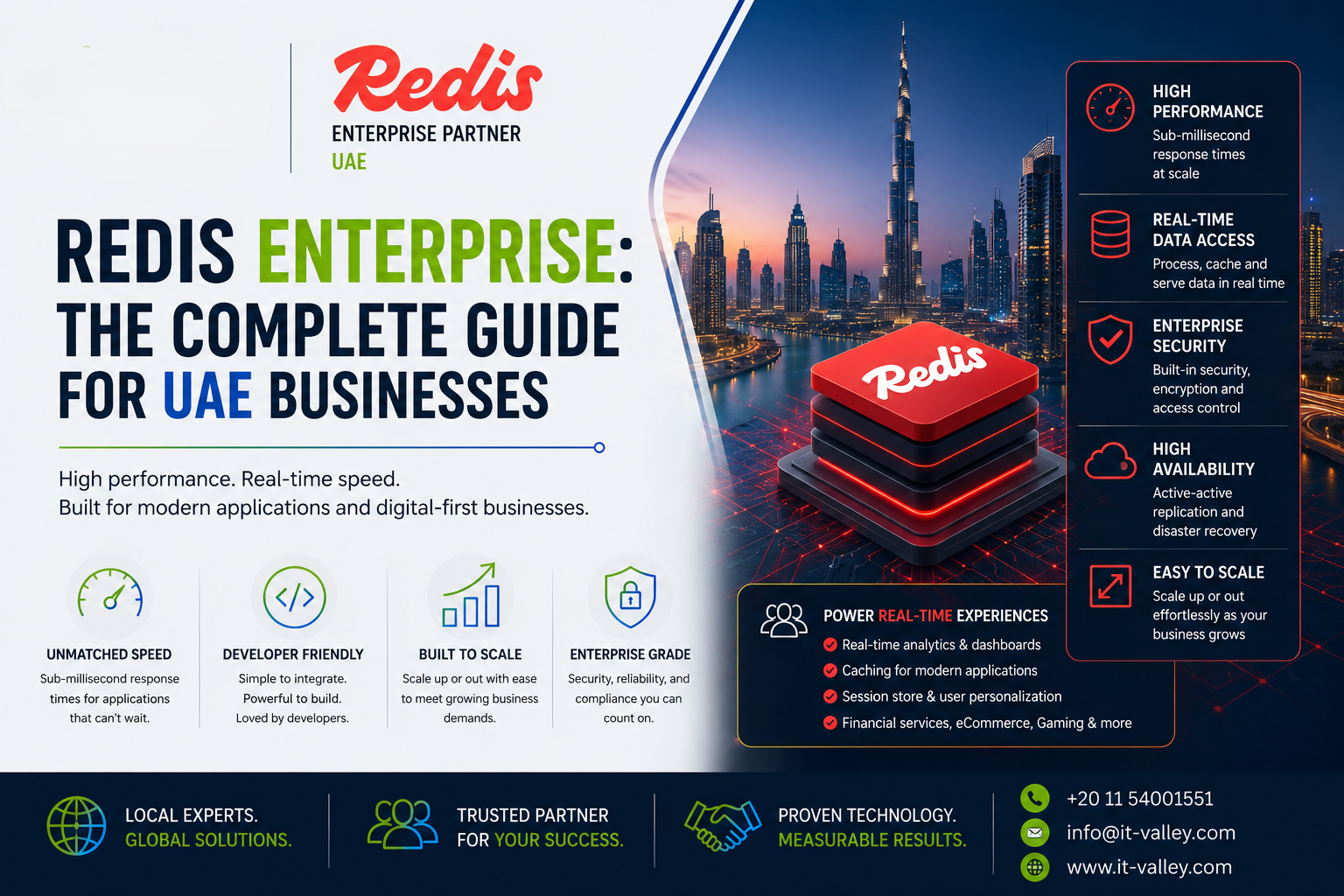
Redis Enterprise: The Complete Guide for UAE Businesses
Redis Enterprise is what most UAE companies end up buying once open-source Redis stops being enough. A checkout page that hangs for three seconds loses customers. A fraud-detection model that scores a transaction 400 milliseconds too late approves the wrong charge. Both problems trace back to the same bottleneck: a database that wasn’t built for sub-millisecond reads.
That’s the gap Redis was designed to close, and it’s why Redis cache and Redis database deployments have become the default answer for UAE enterprises running high-traffic applications, real-time analytics, or session management at scale — from Dubai’s retail platforms to Abu Dhabi’s financial institutions.
None of this is new technology. Redis — short for Remote Dictionary Server — has been around since 2009, originally written by Salvatore Sanfilippo. What changed over the years is how enterprises actually deploy it, and that’s exactly where most procurement decisions in the UAE go sideways.
Redis Isn’t One Product Anymore
Ask five vendors “should we use Redis?” and expect five different answers. Redis today is really four distinct offerings, and mixing them up is the most common mistake we see in UAE deployments.
Open-source Redis is the free, self-managed version. You install it, patch it, and scale it yourself. That’s fine for a dev team with spare DevOps capacity. It’s risky for a bank running PCI DSS-regulated payment flows without dedicated 24/7 monitoring.
Redis Enterprise adds active-active geo-replication, Redis on Flash for cost-efficient large datasets, and enterprise-grade role-based access control. Most UAE financial institutions and government-linked entities land on this tier once compliance audits start asking about data residency and encryption at rest.
Cloud-managed Redis — AWS ElastiCache for Redis, Azure Managed Redis, or Google Cloud Memorystore — hands infrastructure management to the hyperscaler. AWS ElastiCache alone processes trillions of requests daily across its customer base. The tradeoff: you’re locked into that cloud’s networking and pricing model, and into whichever UAE-region availability zone it offers.
Redis Cloud, Redis Inc.’s own managed service, sits closer to the database vendor and ships with modules open-source Redis doesn’t include by default — RedisJSON, RediSearch, and RedisTimeSeries among them.
One note worth flagging for anyone mid-procurement in the UAE right now: Microsoft is retiring the classic Azure Cache for Redis service (September 2028 for Basic/Standard/Premium tiers, March 2027 for Enterprise tiers) in favor of Azure Managed Redis. If your team is still speccing “Azure Redis cache” in a new RFP, check the current product name first — it affects long-term support timelines.
Getting this choice wrong isn’t a minor line-item mistake. It’s the difference between a $50/month dev instance and a six-figure annual commitment that still can’t hit your recovery point objectives.
Where Redis Actually Earns Its Keep in the UAE
Three use cases dominate what we see across UAE enterprise environments.
Session storage for high-traffic web platforms. E-commerce sites during Ramadan or White Friday traffic spikes can’t afford a relational database doing session lookups under load. A Redis in-memory database handles this in under 1 millisecond, versus 10–50ms for a disk-based equivalent.
Caching layers in front of legacy databases. A Dubai-based telecom or bank’s billing system built on Oracle doesn’t need a rebuild — it needs a Redis cache absorbing 80–90% of read traffic so the primary database only handles writes and cache misses. This single pattern is the most common Redis deployment IT Valley’s infrastructure team encounters across UAE retail and telecom clients.
Real-time leaderboards, rate limiting, and pub/sub messaging. Gaming platforms, ride-hailing apps, and IoT fleets across Dubai and Abu Dhabi lean on Redis’s native data structures — sorted sets, streams, geospatial indexes — to handle workloads that would otherwise need custom code bolted onto a traditional relational database.
Redis also runs well inside containerized environments. Teams standardizing on Redis Kubernetes operators or a Redis Docker image for local development tend to move the same configuration into Redis Enterprise clusters once they hit production, keeping the operational model consistent from laptop to cluster.
The PDPL Compliance Question Nobody Skips Anymore
The UAE’s Federal Decree-Law No. 45 of 2021 on the Protection of Personal Data (PDPL) increasingly comes up during vendor audits, and Redis deployments aren’t exempt. If you’re running Redis Cloud or Redis Enterprise Cloud, ask specifically which region backs your instance. Deployment through AWS’s UAE or Bahrain availability zones is available, but it isn’t automatic — it has to be specified at provisioning, not assumed.
Encryption matters just as much. Redis supports TLS in transit and, in Enterprise tiers, encryption at rest — but open-source Redis leaves both off by default. More than one UAE financial-services environment we’ve reviewed had Redis running unencrypted for months simply because nobody flipped that switch during initial rollout. A quick cybersecurity review at deployment time catches this before an auditor does.
Note that free zones such as DIFC and ADGM run their own separate data protection frameworks rather than the federal PDPL — worth confirming which regime applies before you finalize your Redis hosting region.
Redis Pricing: Where UAE Budgets Get Blown
Redis pricing scales with memory, not storage, which trips up teams used to disk-based database economics. A 50GB cache-optimized ElastiCache Redis node runs meaningfully more per month than 50GB of standard RDS storage, simply because RAM costs more than disk.
Organizations that don’t right-size their dataset — caching everything instead of the roughly 20% of data that’s actually “hot” — end up paying for capacity they never touch. Redis on Flash, available in Enterprise tiers, addresses this by tiering colder data to SSD, cutting memory costs by roughly 70% on large datasets in exchange for a modest latency tradeoff.
Managed Redis as a service also carries a support premium over self-hosted Redis server instances. That premium is usually worth it the moment your uptime SLA matters more than your infrastructure budget — but it’s worth pricing out both paths before signing anything, especially against Dubai and Abu Dhabi’s typically higher hyperscaler rates versus other regions.
Getting the Deployment Right
The choice between self-managed Redis, Redis Enterprise, and cloud-managed Redis comes down to what you already run, what your UAE regulator expects, and how much DevOps bandwidth you actually have — not which option has the flashiest marketing page.
IT Valley runs a dedicated UAE branch in Dubai as part of a two-decade regional track record architecting infrastructure, platform, and DevSecOps deployments for telecoms, banks, and government entities. That background shapes how we scope a Redis Enterprise rollout for UAE clients: start with the workload, then pick the tier — and back it with managed IT services once it’s live.
Weighing Redis against alternatives, or already running it and hitting cost or PDPL compliance friction in the UAE? Get in touch — a short architecture review tends to surface the actual fix faster than another round of vendor calls.