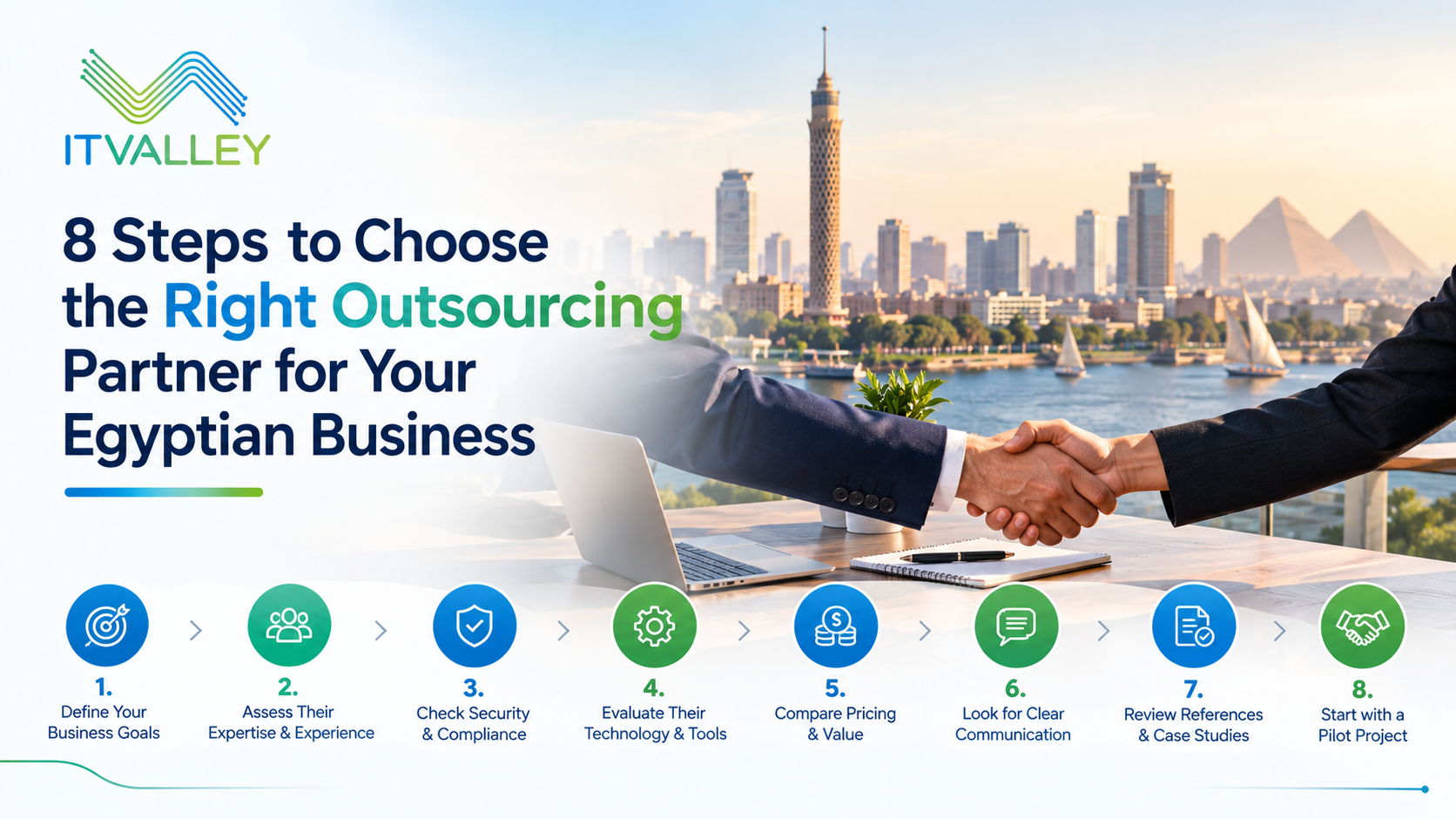
8 Steps to Choose the Right Outsourcing Partner for Your Egyptian Business
Choose the right outsourcing partner, and your company gains speed, skills, and breathing room. Choose the wrong one, and you get missed deadlines, surprise invoices, and a lot of stress. That is why the decision deserves a clear process, not a quick phone call and a cheap quote. In this guide, IT Valley walks you through eight practical steps that help Egyptian companies pick a reliable outsourcing company, whether you need IT support, software development, or managed services.
Why Egyptian Companies Are Turning to Outsourcing
Business in Egypt moves quickly. Companies in Cairo, Alexandria, and the new administrative capital want to grow, yet hiring skilled people takes time and money. A good engineer may take months to find, and a full in-house team is a heavy fixed cost.
Outsourcing solves part of that problem. You get experienced people on demand, you pay for the work you need, and your own team stays focused on the core business. Egypt is also a strong market for IT outsourcing, thanks to a large pool of technical graduates and a time zone that works well with Europe and the Gulf. Still, the benefits only appear when you pick the right partner.
Step 1: Define What You Actually Need
Start with your own house. Before you speak to any vendor, write down the problem you want to solve. Do you need a help desk, a new app, network management, or cloud migration? Be as specific as you can.
Next, list your goals. For example, you may want to cut IT costs by a set percentage, reduce downtime, or launch a product by a certain date. A clear brief helps vendors give accurate quotes, and it helps you compare them fairly. Without it, every proposal looks different, and the decision becomes a guess.
Step 2: Decide What to Outsource and What to Keep
Not everything should leave your company. As a rule, outsource tasks that are repeatable or highly technical, such as server monitoring, IT support, or software testing. Keep strategic decisions and sensitive knowledge in-house.
Consider the model too. Some firms outsource a single function. Others hire a team that works as an extension of their own staff. Both can work, so choose the one that matches your size and your management style.
Step 3: Check Experience and Real References
A polished website proves very little. Ask the outsourcing company about projects similar to yours, and ask to speak with real clients. A confident partner will happily share references.
Look for experience in your industry as well. A partner that already understands banking rules, healthcare data, or retail systems will learn faster and make fewer mistakes. Also check how long the company has operated and how many people work on the team. Stability matters when you plan a long relationship.
Step 4: Look at Technical Skills and Certifications
Skills should be visible. Ask which technologies the team uses and how they keep up with changes. Certifications and vendor partnerships are a useful signal, since they show the company passed formal checks. For instance, a team with partner status from major technology brands usually has proven training and direct access to vendor support.
Don’t stop at paper, though. Request a short technical discussion with the people who would actually do your work. A great sales presentation means little if the engineers cannot answer simple questions.
Step 5: Test Communication and Cultural Fit
Communication problems sink more projects than technical ones. During your first meetings, pay attention. Does the vendor answer quickly? Do they ask smart questions? Do they explain things in simple language?
Language matters in Egypt, so confirm that the team works comfortably in both Arabic and English. Also agree on working hours, meeting rhythm, and reporting style from day one. A weekly call and a short written update are often enough to keep everyone aligned.
Step 6: Review Security and Legal Safeguards
When you outsource, you share data, systems, and sometimes passwords. Therefore, security cannot be an afterthought. Ask how the vendor protects client data, who has access, and what happens if something goes wrong.
Egypt has its own Personal Data Protection Law, Law No. 151 of 2020, which companies must respect. A professional partner should understand it and explain how they comply. Sign a non-disclosure agreement (NDA) before sharing sensitive details, and make sure your contract states who owns the code, documents, and data at the end of the project.
Step 7: Compare Pricing Models and Hidden Costs
The lowest price is rarely the best deal. Cheap quotes often hide extra fees, limited support hours, or junior staff who need constant guidance. Instead, compare the total cost over the full period.
Learn the common pricing models:
Fixed price: Best for clear projects with a defined scope.
Time and materials: Best when requirements may change.
Monthly retainer: Best for ongoing IT support and managed services.
Ask what happens when you need extra work, and what an urgent request costs. Clear answers now prevent arguments later.
Step 8: Start with a Pilot and Set Clear KPIs
Even after a good review, take a careful first step. Begin with a small pilot project, or a short trial period. This gives you a real look at how the partner works, with limited risk.
Then agree on a service level agreement (SLA) and measurable KPIs. Good examples include response time, resolution time, uptime, and delivery dates. Review the numbers monthly, and talk openly about what works and what doesn’t. A strong partner welcomes this kind of honest feedback.
Common Mistakes to Avoid
Many companies repeat the same errors. Some choose only on price. Others skip the contract details, or hand over everything on day one. A few forget to plan an exit, so they find themselves locked in with no easy way out.
Avoid these traps by writing down your expectations, keeping a copy of your key data and documents, and including clear termination terms. A good outsourcing partnership should feel like teamwork, not dependency.
How IT Valley Supports Egyptian Businesses
IT Valley helps companies in Egypt put these steps into practice. Our team starts by understanding your goals and your current setup. Then we recommend the right services, from IT support and infrastructure to managed services, and we work under clear SLAs. We also hold partnerships with leading technology vendors, which helps us deliver tested solutions and reliable support.
Most important, we communicate openly. You will always know what we are doing, why we are doing it, and what it costs.
Next Step
If you want to choose the right outsourcing partner with confidence, talk to IT Valley. Tell us about your business, your challenges, and your goals. We’ll suggest a practical plan and send a clear proposal, with no pressure.