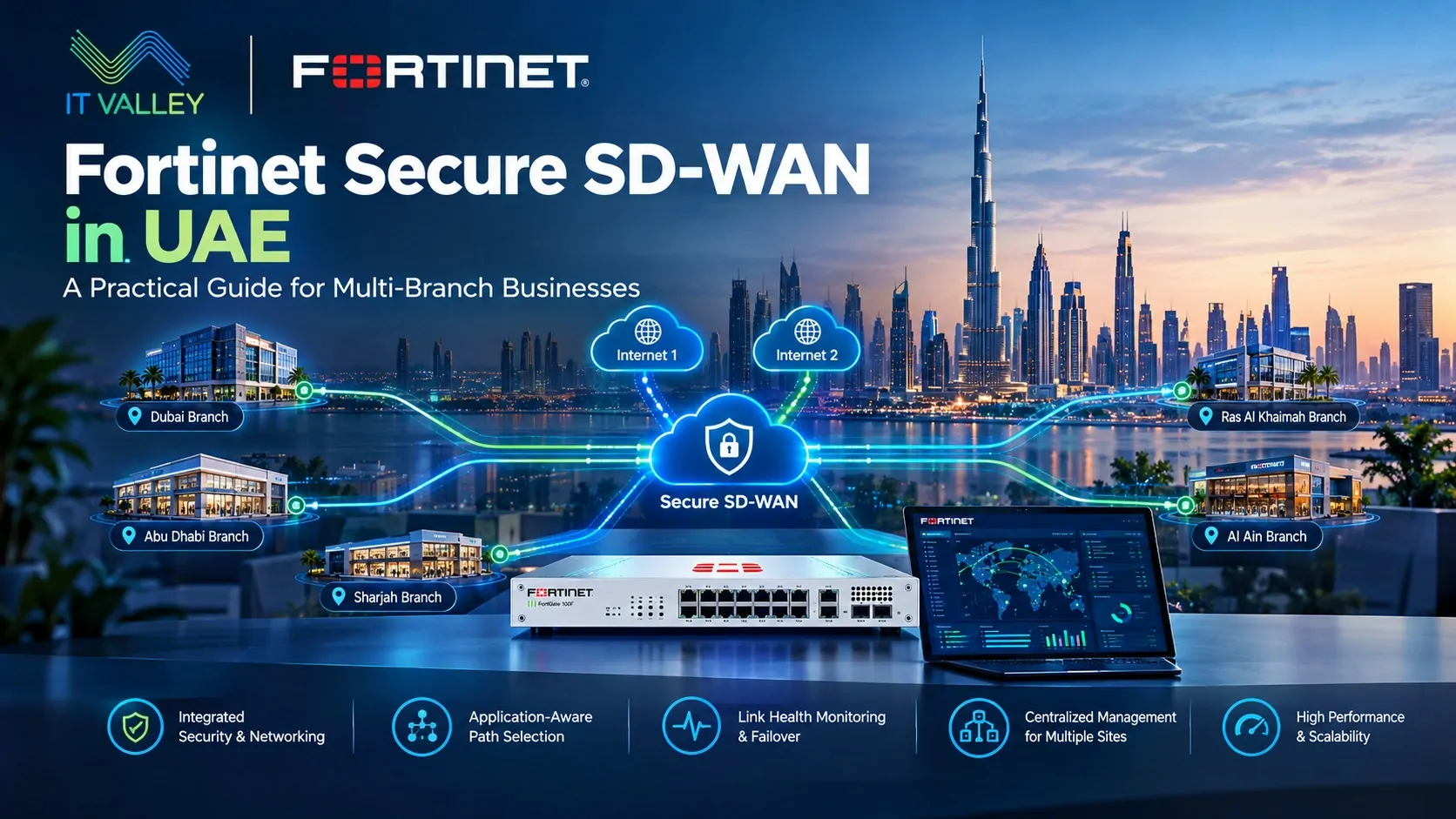
Fortinet Secure SD-WAN in UAE: A Practical Guide for Multi-Branch Businesses
Fortinet Secure SD-WAN in UAE solves a problem that many growing companies know too well: slow cloud apps, dropped video calls, and a branch network that nobody fully trusts. Your head office may sit in Dubai, with shops in Sharjah, a warehouse in Abu Dhabi, and staff working from home. Connecting all of them safely is hard with old tools. This guide explains what Secure SD-WAN is, how Fortinet’s approach works, and what to check before you deploy it. It comes from IT Valley, a Fortinet partner with a Dubai office.
What Is Secure SD-WAN?
SD-WAN stands for software-defined wide area network. In plain words, it is a smarter way to connect your sites. Instead of sending everything through one expensive private line, it uses several connections at once, such as fiber, broadband, and 5G, and picks the best path for each application. If you want a short definition, Fortinet explains it well in its SD-WAN glossary.
The word “secure” matters here. Many SD-WAN products move traffic well but treat security as an add-on. Fortinet takes the opposite view. According to Fortinet, its solution combines networking and security in one platform, with one operating system (FortiOS) and one management console. That means the firewall and the SD-WAN are the same device, not two products stitched together.
Why UAE Businesses Need SD-WAN Now
The UAE market moves fast, and networks have to keep up. Several trends push companies toward SD-WAN.
First, cloud use keeps growing. Email, CRM, accounting, and video meetings all run on the internet, so branch connections matter more than ever. Second, more people work from several places. A traditional network built around one data center struggles with that. Third, costs matter. Private MPLS circuits are reliable but expensive, especially when you add new branches.
Retail chains, hotels, clinics, logistics firms, and banks feel this pressure most. They run many small sites that all need the same security rules and stable access to the same systems.
How Fortinet Secure SD-WAN Works
At the center is the FortiGate, a next-generation firewall with SD-WAN built in. It watches each connection in real time and measures delay, loss, and jitter. When a link gets worse, it moves the affected traffic to a better path automatically. Fortinet calls this an autonomous, application-aware design, and it keeps working without anyone touching a router.
Here’s a simple example. A branch has a fiber line and a 5G backup. Video calls run on fiber. When the fiber slows down, FortiGate shifts the calls to 5G within moments, while less urgent traffic, such as software updates, stays on the slower path. Your staff may not even notice a problem.
Deployment is also quick. With zero-touch provisioning, a new branch device can be shipped to the site, plugged in, and configured from the center. For a company opening five new locations this year, that saves a lot of travel.
Built-In Security, Not Bolted On
Security is where Fortinet differs most from many rivals. The FortiGate inspects traffic locally at each branch, so nothing has to travel to a distant data center first. Fortinet uses purpose-built chips (ASICs) to inspect encrypted traffic without slowing it down much, which matters because most web traffic is now encrypted.
The same platform supports zero trust access, which means users and devices get verified before they reach an application. It also includes FortiGuard security services, such as intrusion prevention, web filtering, and malware protection. As a result, one policy protects every site, instead of a different setup at each branch.
Easier Management with One Console
Managing dozens of branches one by one is painful. Fortinet offers FortiManager to configure and monitor many FortiGate devices from a single place. You write a policy once and push it everywhere.
Visibility improves too. Fortinet’s digital experience monitoring tracks how users actually experience an application, from the laptop to the internet provider to the cloud service. When someone says “the system is slow,” your team can see where the problem sits. Fortinet also offers FortiAI-Assist, a generative AI helper that speeds up troubleshooting and daily tasks.
Predictable Costs
Budget surprises are common in network projects. Fortinet states that its Secure SD-WAN has no licensing based on bandwidth, data transfer, or service tiers. In practice, you can raise your internet speed later without paying a new license fee to the SD-WAN vendor.
Moving some sites from MPLS to broadband and 5G can lower running costs further. Still, savings depend on your current contracts and quality of local internet, so ask for a proper assessment before promising numbers to your finance team.
Choosing the Right FortiGate Model
Fortinet sells SD-WAN on many appliances, so size matters. Small branches often fit the FortiGate 40F or FortiGate 60F. Larger offices may need the 90G, 200F, or 400F. Head offices and data centers use bigger models as hubs, and virtual FortiGates work well for public cloud.
Don’t choose by price alone. Look at throughput with security features switched on, the number of users per site, and your expected growth. A small saving today becomes a headache when a branch doubles in size.
From SD-WAN to SASE
Many UAE companies also support remote staff and travelers. Here, SD-WAN can grow into SASE, which delivers security from the cloud to users anywhere. Fortinet says its Secure SD-WAN integrates with FortiSASE, so you can extend the same policies to remote workers later. If you want to understand the difference, this comparison of SASE vs SD-WAN is a useful read. You don’t need to buy everything today, but it helps to choose a platform that can grow.
Meeting UAE Data and Security Expectations
Compliance is part of network design in the UAE. Companies must protect personal data under the UAE Personal Data Protection Law, and organizations linked to the Dubai government often follow the Dubai Electronic Security Center’s Information Security Regulation. Secure SD-WAN supports these goals with encrypted tunnels, network segmentation, central logging, and consistent access policies. However, no product delivers compliance on its own. Your policies and processes still matter.
Five Questions to Ask Before You Deploy
Before you sign a contract, answer these:
How many sites do you have, and how many will you add in two years?
Which applications are critical, such as voice, ERP, or point of sale?
What internet links does each branch have, and is there a backup?
Do you want to manage the network yourself or use a managed service?
What support level and response time do you need?
If you want a deeper checklist, Fortinet publishes a helpful Secure SD-WAN buyer’s guide.
How IT Valley Delivers Fortinet Secure SD-WAN in the UAE
IT Valley is a regional system integrator with about two decades of experience and offices in Egypt, the UAE, KSA, and the UK. Our Dubai team handles the full journey, from assessment and design to installation and support. You can learn more about our network services in the UAE and our cybersecurity solutions in the UAE.
Prefer to hand over daily operations? Our managed IT services in the UAE let your team focus on the business while we monitor links, update firmware, and respond to issues.
Next Step
If you’re planning Fortinet Secure SD-WAN in UAE for your business, talk to IT Valley. Tell us how many sites you run, what applications matter most, and what problems you face today. We’ll suggest a practical design and send a clear quote.