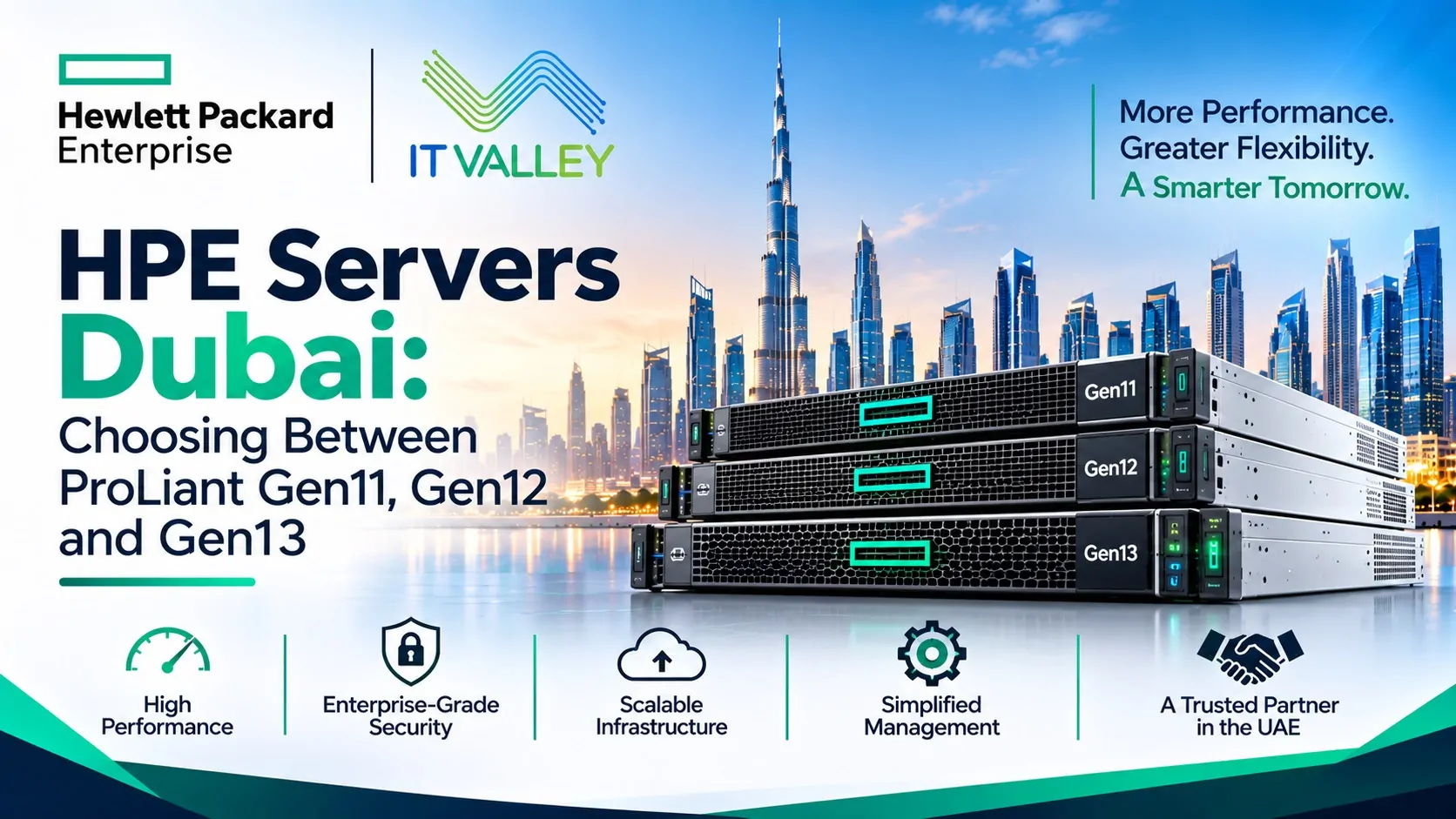
HPE Servers Dubai: Choosing Between ProLiant Gen11, Gen12 and Gen13
HPE servers Dubai buyers face a timing problem that didn’t exist a year ago. Gen11 is established, Gen12 is shipping, and in October 2026 HPE announced a first wave of Gen13 systems. Meanwhile, many Dubai data rooms still run Gen10 or Gen9 DL380 servers that were bought years ago and kept alive by habit. This guide helps IT managers and CIOs decide what to buy, what to phase and what to leave alone. It covers generations, sizing, iLO security, GPUs and the buying process. It comes from IT Valley, an HPE partner and system integrator with a Dubai office.
Searching for “HP servers”? You mean HPE ProLiant
Servers are built and sold by Hewlett Packard Enterprise (HPE) under the ProLiant brand. People still search for “HP servers” and “Hewlett Packard servers”, and old names such as “HP DL380” persist in quotes. When you request a quote, use the HPE model name and generation, for example “ProLiant DL380 Gen12”. It removes ambiguity and makes quotes easier to compare.
Gen11, Gen12 or Gen13: what actually differs
Gen11 is the mature platform. The DL380 Gen11 uses 4th and 5th Generation Intel Xeon Scalable processors and is still sold through HPE’s UAE storefront. It’s a safe choice when you need a known quantity.
Gen12 moves to Intel Xeon 6. According to the HPE DL380 Gen12 page, the 2U, dual-socket server supports up to 144 cores, up to 8 TB of DDR5 at up to 6400 MT/s, air or direct liquid cooling, and GPU options such as up to eight single-wide NVIDIA L4 or three double-wide L40S, H100 NVL or RTX PRO 6000 Blackwell cards. HPE says it delivers up to twice the average general compute performance of previous generations. Treat that as a vendor figure and test with your workload. The QuickSpecs list PCIe Gen5 and the management stack.
Gen13 arrived in October 2026. As IT Brief reported, HPE introduced four AMD EPYC 6th Generation systems: the DL525 Gen13, DL585a Gen13, XD245 Gen13 and XD285 Gen13. The DL525 is a 1U single-socket server with up to 256 cores, 16-channel memory and PCIe Gen6. The DL585a supports up to eight double-wide GPUs. The XD systems follow Open Compute Project designs for dense racks. Note what’s missing: the first wave doesn’t include a mainstream DL380 or DL360. Confirm availability and delivery dates in the UAE before planning around them.
How to choose:
Fixed deadline, standard virtualisation or databases: Gen12 for new purchases, Gen11 where standardisation or a proven build matters more than the latest chip.
High core density or GPU-heavy inference: look at the Gen13 DL525 and DL585a once delivery is confirmed.
Existing Gen10 or Gen9 estate: plan the replacement now, so you aren’t forced into an emergency purchase.
Size for software licences, memory and I/O, not just core counts
More cores aren’t always better. If your database or virtualisation software is licensed per core, a 144-core server can cost more in licences than it saves in hardware. Work backwards from licence cost.
Then check memory and I/O. Populate all memory channels, because under-filled channels waste bandwidth. For storage-heavy designs, check how many NVMe or EDSFF E3.S bays you need. The DL380 Gen12 supports up to 36 E3.S drives, according to HPE. Match network cards to the expected traffic, and confirm rack power and cooling, especially for GPU or liquid-cooled configurations.
iLO and Compute Ops Management: where server security lives
Every ProLiant has an iLO management controller, and it’s often the least protected part of the stack. On Gen12, iLO 7 adds a secure enclave and a silicon root of trust, and HPE says it signs firmware using quantum-resistant algorithms. Gen13 moves to iLO 8, with multi-person authorisation, which requires two authorised users to approve actions such as key provisioning and secure erase, according to HPE.
Whatever the generation, apply the basics:
Put iLO on an isolated management network, never on the user LAN or the internet.
Enforce strong authentication and remove default accounts.
Set a firmware baseline and patch it on a schedule.
Use secure erase when you retire servers.
For many sites, HPE Compute Ops Management adds a cloud console for onboarding, compliance monitoring and power visibility. HPE cites a commissioned Forrester study on time savings. Take any such figure as a vendor claim and measure your own results.
Virtualisation, HCI and AI workloads
ProLiant supports the main virtualisation platforms, including VMware, Microsoft Hyper-V and Nutanix. If you’re reviewing your hypervisor, decide that first, because it affects licences, hardware certification and the number of hosts. Our virtualisation team can help compare the options.
For AI, start with inference, not training. A GPU-capable DL380 Gen12 can cover many enterprise use cases, and a DL585a-class server suits heavier inference and fine-tuning. Check facility power, cooling and your data pipeline first. If you need a pilot before buying, consider renting GPU capacity.
Buying HPE servers in Dubai: the checklist
Whether you buy from a reseller, an integrator or a distributor, ask for:
An itemised quote with exact part numbers, processor, memory, drives, RAID and network cards.
The warranty term and any HPE Tech Care or support upgrade.
Delivery lead time to the UAE and installation scope.
Confirmation that the support entitlement is registered for the serial numbers.
Clear VAT, because UAE quotes may add 5%.
Be cautious with grey-market or refurbished servers for production. Cheap hardware without valid support can cost much more during an outage.
Moving off Gen9 and Gen10: a short plan
Inventory every server, its role, age and warranty status.
Measure real CPU, memory and storage use over a month.
Count software licences per core before choosing a new configuration.
Pick the target generation and build a standard configuration.
Migrate in waves, testing backup and failover each time.
Retire old hardware with secure erase and documentation.
Plan the cutover around your backup and business continuity requirements, and set RPO and RTO per application.
Working with IT Valley as your HPE partner
IT Valley is a regional system integrator with about two decades of operations and offices in Egypt, the UAE, Saudi Arabia and the UK. Our UAE team helps you size HPE servers, plan migration, secure the management layer and support the result. See our IT infrastructure solutions, our cybersecurity services and our managed IT services.
Get a Sized, Itemised HPE ProLiant Quote for Your Dubai Environment
Choosing the wrong generation, core count or support level is expensive to fix later. Before you commit to a purchase, have IT Valley review your requirements and build the configuration with you.
Send us three things:
What you run today: server models, age and roles, or the workloads you plan to host.
What is driving the change: an expiring warranty, a licence audit, a new application or an AI project.
Your timeline and budget range.
You’ll get a clear recommendation on the right ProLiant generation and model, an itemised quote with exact part numbers, warranty and support terms, and a proposed migration approach. Everything is shown with VAT, so you can compare it line by line with any other offer.