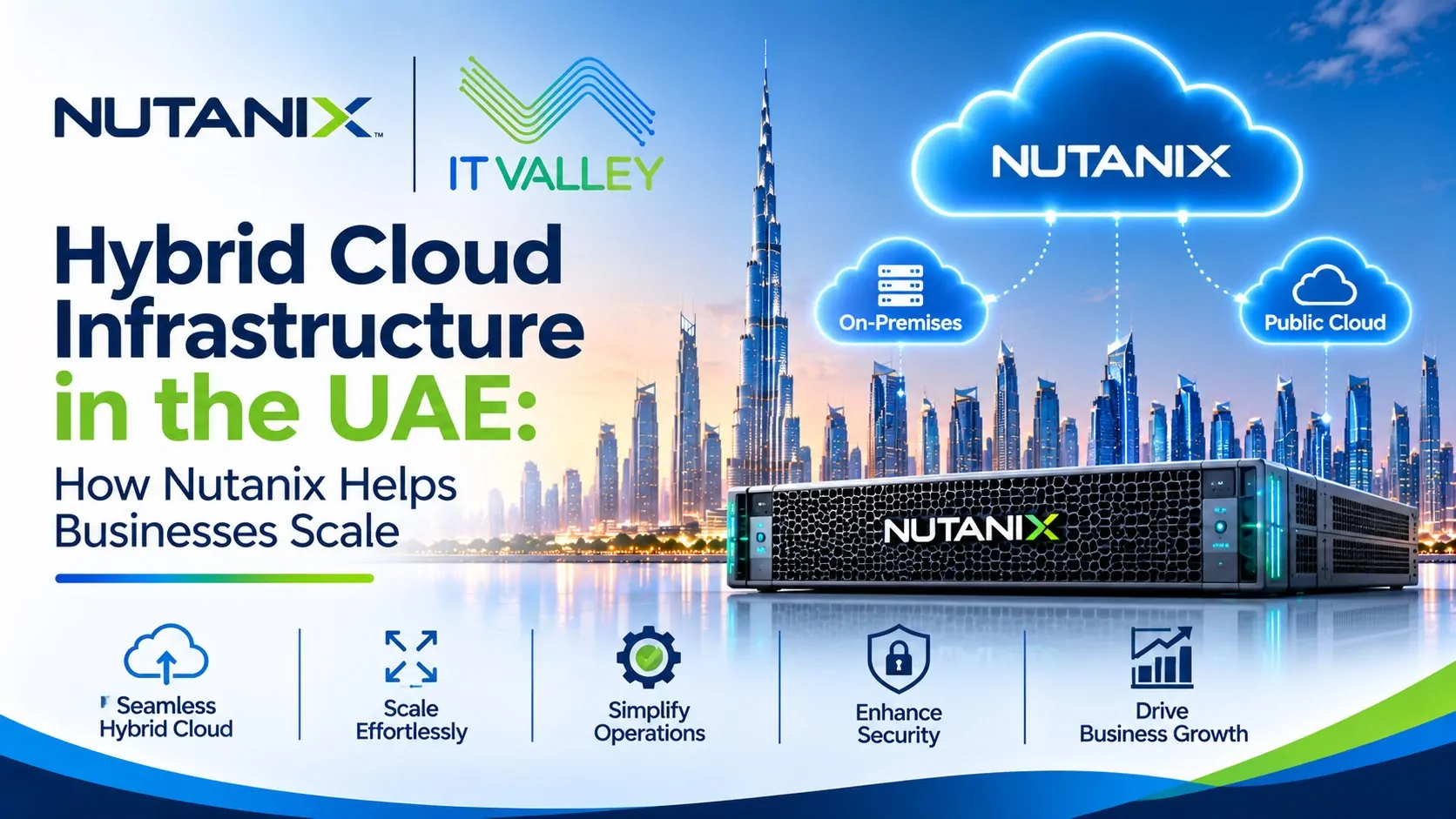
Hybrid Cloud Infrastructure in the UAE: How Nutanix Helps Businesses Scale
Hybrid cloud infrastructure in the UAE is rarely a clean choice between your own data centre and a public cloud. It’s a mix. Core systems stay close for latency or data-location reasons, while new projects, demand spikes and disaster recovery move to the cloud. The pain starts when each side has its own tools, licences and skills. This guide explains how Nutanix approaches that problem, where its architecture helps IT managers and CIOs, and what to check before you commit. It comes from IT Valley, a Nutanix partner with a Dubai office.
What breaks in hybrid cloud: two operating models
Most hybrid estates fail on consistency, not capacity. On-premises runs one hypervisor, one storage system and one backup tool. The cloud runs another set. Every migration then means refactoring, retraining and re-licensing.
Nutanix attacks that gap by using one software layer in both places. On its website, Nutanix presents the Nutanix Cloud Platform as a single operating model for apps, data and AI anywhere. It also cites its Leader position in Gartner’s 2026 Magic Quadrant for Distributed Hybrid Infrastructure. Treat both as vendor statements, and test them against your own requirements.
The building blocks of Nutanix hybrid cloud
Nutanix Cloud Infrastructure (NCI) combines three things: AOS for distributed storage, which pools disks across nodes; AHV, the built-in hypervisor; and Prism for management. Around them sit Nutanix Flow for microsegmentation, Nutanix Disaster Recovery for replication and failover, and Nutanix Cloud Manager for operations, self-service and cost control.
This is hyperconverged infrastructure (HCI). Compute and storage live in the same nodes, and you scale by adding nodes instead of redesigning the stack.
Scaling on-premises: HCI or external storage
The simplest scale-out pattern is adding nodes to a cluster. Capacity and performance grow together, and full-stack updates run through one tool. Size from real workload data using Nutanix’s Sizer, not from guesses.
Not everyone wants to retire their arrays. NCI with External Storage lets you run Nutanix compute and AHV on qualified storage partners. Nutanix lists Dell Storage, Everpure and NetApp. If you own recent storage, this can protect your investment. Check which models and versions are qualified before you design around it.
Extending to public cloud with Nutanix Cloud Clusters (NC2)
This is the core of the hybrid story. Nutanix Cloud Clusters runs the same Nutanix software on public-cloud bare-metal infrastructure. According to Nutanix, it uses the same data and management planes on-premises and in the cloud, so VMs move without refactoring.
The technical points that matter:
Clouds: NC2 runs on AWS and Azure, and Nutanix lists other clouds too. Check current availability for the cloud you plan to use.
Licensing: bring your own term licences (AOS Pro or Ultimate, since Starter isn’t supported), pay per core-hour, or sign a cloud commit. Licences can move between on-premises and cloud.
Control: NC2 isn’t a managed service. You decide when to deploy and when to bring workloads back.
Speed: Nutanix says clusters can be deployed in a few hours, which helps with bursts and hardware delays.
Before you design around it, confirm which regions and bare-metal node types are available for your UAE needs. Nutanix directs customers to its support portal for that detail.
Migrating with Nutanix Move
Nutanix Move migrates workloads from ESXi, AWS-native and Azure-native environments, VMware Cloud and Azure VMware Solution to Nutanix. If you’re reviewing your hypervisor strategy, our virtualisation team can help you plan it.
A practical approach: inventory your VMs, group them by risk and migrate a pilot wave first. Test application dependencies, licensing and backups before cutover, and keep a rollback plan for every wave.
Disaster recovery in a hybrid design
Set RPO and RTO per application, not for the whole company. Nutanix describes VM-centric replication and failover. For cloud DR, it says NC2 can offload snapshots from on-premises clusters to AWS S3 and start a secondary cluster on demand. That can reduce the cost of keeping a second site idle. Whatever design you choose, rehearse the recovery. Our business continuity team builds those tests around your targets.
Containers, databases and AI on one platform
Hybrid cloud now includes more than VMs. Nutanix Kubernetes Platform covers containers, Nutanix Database Service automates database operations, and Nutanix Enterprise AI targets running AI where your data lives. Nutanix says this keeps control over token costs, data sovereignty and operations.
Sequence it sensibly. Start with inference, not training, fix your data layer first, then check GPU availability, power and cooling.
Governance and cost
Hybrid cloud can raise costs quietly. Nutanix Cloud Manager brings together intelligent operations, self-service, cost governance and security compliance, so you can see who runs what and where. Compare total cost over three to five years: licences, cloud consumption, hardware, support and staff time. Your own numbers matter more than any vendor’s study.
A UAE hybrid cloud checklist
List workloads by data sensitivity, latency and criticality.
Confirm data-location rules with your regulator or legal counsel. In Dubai, DESC develops the Information Security Regulation for government entities and critical non-government entities, as set out in Dubai Law No. 15 of 2024.
Decide what stays on-premises, what moves to cloud and what bursts.
Verify cloud region and node availability before you design.
Plan network links, identity and segmentation across sites.
Define RPO and RTO per application, and test recovery.
Estimate three-to-five-year cost, including licences and data transfer.
Plan skills: who will operate AHV, NC2 and the cloud accounts?
Working with IT Valley as your Nutanix partner
IT Valley is a regional system integrator with about two decades of operations and offices in Egypt, the UAE, Saudi Arabia and the UK. Our UAE team helps you assess workloads, size clusters, plan migration and support the result. See our IT infrastructure solutions, cybersecurity services and managed IT services.
Get a Hybrid Cloud Assessment for Your UAE Environment
Moving to hybrid cloud without a plan creates new silos. Before you buy nodes, licences or cloud capacity, have IT Valley review what you run today and where it should live.
Send us three things:
Your current stack: hypervisor, storage, backup and cloud accounts.
What is driving the change: a VMware review, capacity pressure, DR gaps or an AI project.
Your timeline and constraints, including data-location rules.
You’ll get a clear recommendation on workload placement, a sized Nutanix design and a migration approach, with costs you can compare line by line.