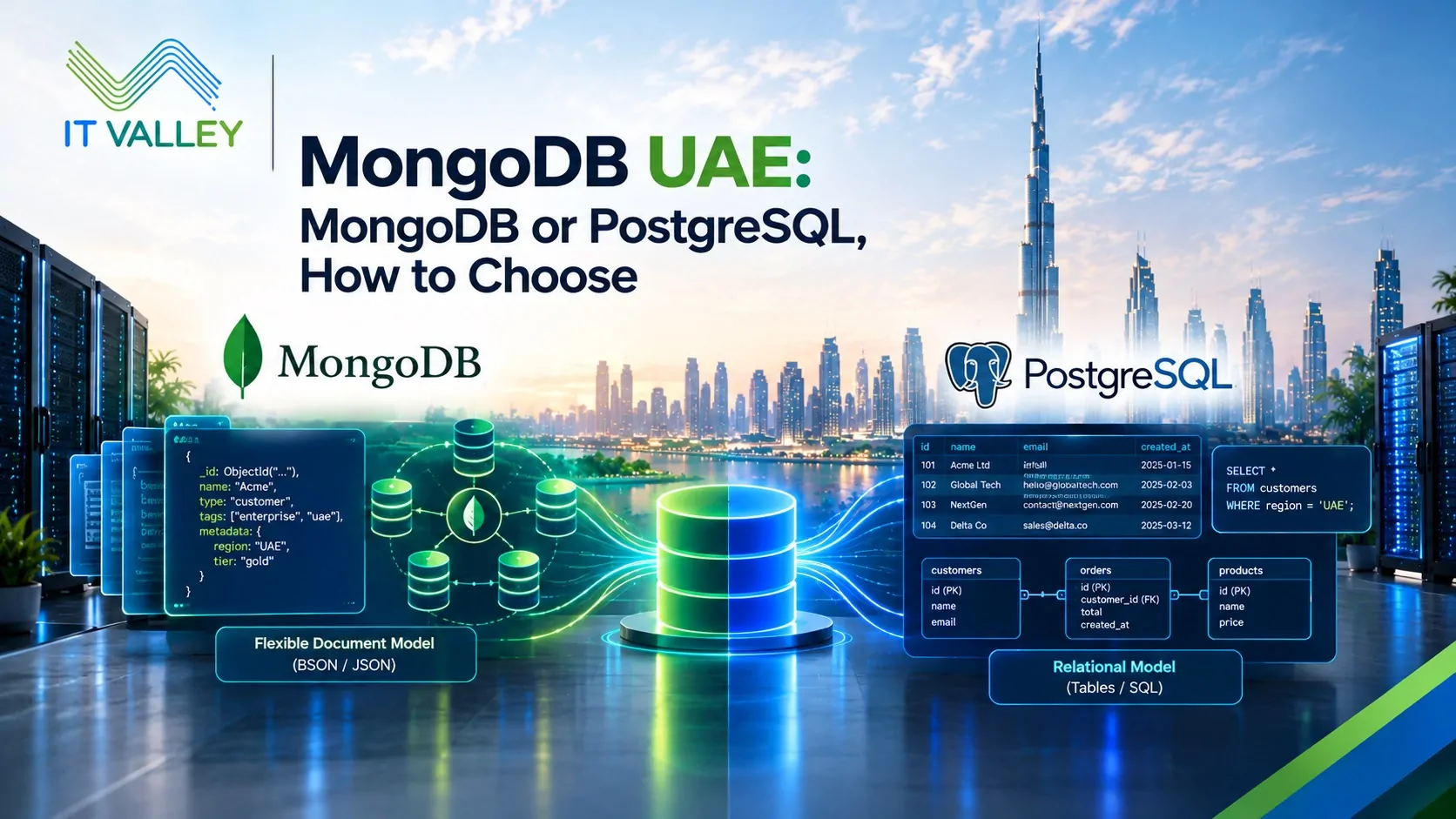
MongoDB UAE: MongoDB or PostgreSQL, How to Choose
MongoDB UAE searches often hide a bigger question. Should we use MongoDB at all, or would PostgreSQL serve us better? Both are strong, popular, and trusted in production. Both can run a serious business. But they’re built around different ideas, and picking the wrong one costs real time and money later.
IT Valley supports both databases, so we have no reason to push one over the other. If you already know you want MongoDB, our MongoDB Atlas UAE page covers setup and migration, and our MongoDB partner page covers the wider relationship. This post helps you decide whether MongoDB is the right starting point.
The Real Question Behind “Which Database?”
Most database debates focus on features. That’s the wrong place to start. Both databases have long feature lists, and the lists overlap more every year.
A better question is this. What does your data look like, and how will your application use it? Once you answer that honestly, the choice often becomes obvious. The rest is detail.
How the Two Store Data
PostgreSQL is relational. Data lives in tables with fixed columns, and tables connect through keys. Think of a set of well-organized spreadsheets that reference each other. You define the structure first, then fill it in.
MongoDB is a document database. Each record is a flexible document, much like a JSON object, and it can hold nested information inside it. A customer document can contain their addresses, orders, and preferences together, in one place. You don’t have to define every field in advance, and different documents can have different fields.
Neither approach is better in general. Each one simply matches certain kinds of data more naturally.
When MongoDB Is the Better Fit
MongoDB tends to shine when your data changes shape often. A product catalog is a classic case. A phone has a screen size and a battery. A sofa has a fabric and a width. Forcing both into one rigid table gets awkward fast, while documents handle the difference easily.
It also suits teams that move quickly. When a new feature needs a new field, a developer can add it without a formal change to the database structure. For a UAE startup racing to launch, or a retailer testing new offers every week, that speed is valuable.
Other good fits include content platforms, user profiles, logistics tracking, and apps that collect varied data from many sources. MongoDB also has built-in tools for search and vector search, which helps teams building AI features without adding another system.
When PostgreSQL Is the Better Fit
PostgreSQL is often the stronger choice when your data is highly structured. It also wins when the links between records matter most. Accounting, billing, and inventory ledgers fit this pattern well, along with anything built from many connected tables. The database enforces the rules for you, which protects data quality.
It’s also excellent for heavy reporting. If your analysts write complex SQL that joins many tables, PostgreSQL handles that naturally. SQL is widely known too, so hiring and training are usually easier.
For UAE finance teams and regulated firms that need strict, auditable records, that discipline is a real advantage. We often recommend PostgreSQL in those cases, and we say so openly.
Transactions: An Old Myth
Many people still believe MongoDB can’t handle transactions. That was once partly true, but it’s out of date. MongoDB supports multi-document ACID transactions, so several changes can succeed or fail together.
That said, a document database works best when you design your data to need fewer transactions. If your whole app depends on complex, multi-table transactions, a relational database may feel more natural. For most everyday apps, though, MongoDB’s transaction support is plenty.
Search and AI Features
Modern apps increasingly need search and AI. MongoDB offers Atlas Search for full-text search and Atlas Vector Search for finding content by meaning. Both live inside the same platform as your data, so you don’t need a separate search engine.
PostgreSQL can do similar things through extensions, and many teams use them successfully. The difference is mostly in how much you assemble yourself. MongoDB packages these features together, while PostgreSQL gives you more building blocks to choose from. Either path works. It depends on how much control your team wants.
Cost and Licensing
Both databases have free, open-source versions, so the license fee is rarely the real cost. The bigger costs come from people’s time, hosting, and support.
MongoDB’s managed service, Atlas, is billed by usage. It removes a lot of maintenance work, which many teams happily pay for. MongoDB also offers a self-managed edition if you prefer to run it on your own servers. PostgreSQL is typically self-managed or run on a cloud provider’s managed service.
The honest advice is to compare total cost over three years, including the engineering hours your team will spend, not just the monthly bill.
Data Residency in the UAE
For banks, healthcare providers, and government bodies, where the data sits matters as much as how it’s stored. Both databases can run on your own infrastructure inside a UAE data center, which keeps data in the country. Managed cloud options exist for both too, and the right choice depends on your regulator’s rules.
We check residency rules at the start of every project. Changing the setup later costs a lot more.
A Quick Way to Test Your Own Project
Here’s a simple exercise we use with clients. Write down your five most common screens or reports. Then ask two questions about each one.
First, does it need data from many different tables at once? If yes, that points toward PostgreSQL. Second, does it show one rich object, such as a customer or a product, with everything attached to it? If yes, that points toward MongoDB. Most projects lean clearly one way after this exercise. A few split down the middle, and those are the ones worth a longer conversation with an engineer.
Sometimes the Answer Is Both
Many UAE companies don’t choose one. They use PostgreSQL for the core financial records and MongoDB for the customer-facing catalog or content layer. Each database does what it’s best at. This is common, and it works well when someone plans the boundaries clearly.
How IT Valley Helps You Decide
Workload review first. We look at your data shape, query patterns, and growth before recommending anything.
Honest comparison. If PostgreSQL fits better, we tell you, even though we also sell MongoDB.
Migration support. We move data safely in either direction, with testing before the final switch.
Ongoing support. Tuning, backups, and monitoring continue after launch.
Frequently Asked Questions
Is MongoDB faster than PostgreSQL? It depends on the workload. Each one is faster at the things it was designed for. Good design and indexing usually matter more than the choice of database.
Can we switch later if we choose wrong? Yes, but it takes real effort. Moving between a document model and a relational model means redesigning how the data is organized. That’s why we recommend deciding carefully at the start.
Which one is cheaper for a small UAE business? Both can start at very low cost. The difference usually comes from how much maintenance your team handles itself versus paying for a managed service.
Talk to IT Valley About Your Database Choice
Not sure whether MongoDB or PostgreSQL fits your project? Get in touch with IT Valley’s database engineers. We’ll give you a straight answer based on your actual data, not a sales preference.